


Blog > Do You Really Need 20% Down on the MS Gulf Coast?
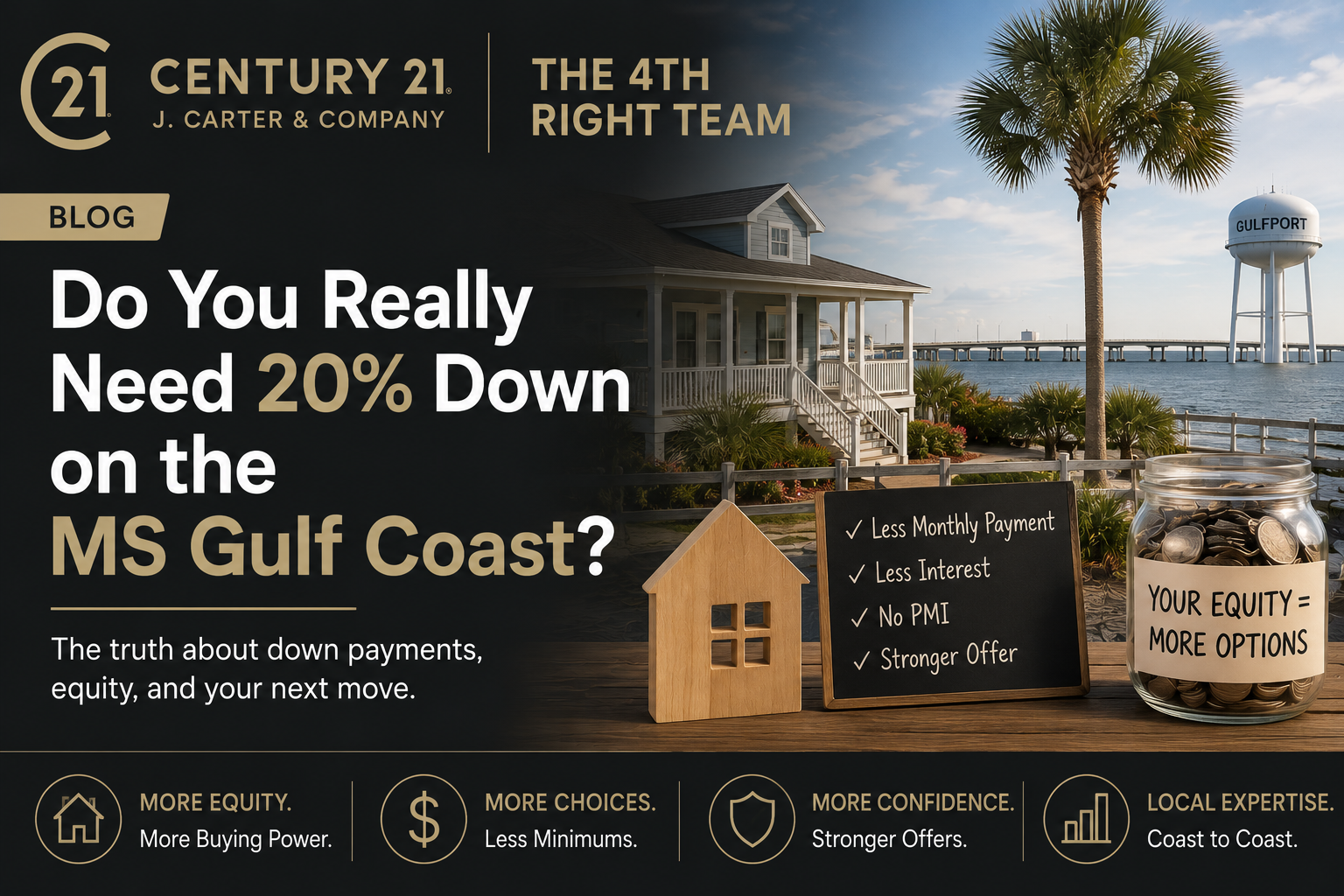
Quick Answer: No, you don't need 20% down to buy a home on the Mississippi Gulf Coast. Plenty of loan options let qualified buyers put down much less. But NAR data shows the typical repeat buyer puts down 23% anyway, more than double the 10% a first-time buyer typically puts down. The reason is usually home equity, not a rule they're following.
Why Repeat Buyers Put More Down
According to the National Association of Realtors, the typical repeat buyer puts down 23% when they buy a home. That's more than double the 10% they likely put down the first time around. The difference usually isn't a bigger paycheck. It's equity.
When you've owned a home for a while, two things happen at once. You pay down your mortgage balance, and your home's value tends to climb. The gap between what you owe and what your home is worth is your equity, and the longer you've owned, the bigger that gap usually gets.
How Equity Turns Into a Down Payment
When you sell, that equity turns into cash. NAR data shows most repeat buyers put that cash straight toward their next down payment. First-time buyers don't have that springboard yet, and that's completely normal. But if you already own a home on the coast, you may be holding more buying power than you realize.
Homeowners nationally have gained an average of $140,900 in wealth over the past five years, according to NAR. On the Gulf Coast, values in Gulfport, Biloxi, and Ocean Springs have all moved higher over that stretch too, even with the market cooling some in the last year or two. If you bought before 2022, there's a real chance your equity has grown more than you'd guess.
What You Get for Putting 20% Down
If your equity puts 20% down within reach, here's what that gets you. A smaller loan means a smaller monthly payment, which matters more than ever with today's rates. You also pay less interest over the life of the loan, since you're only financing 80% of the price instead of 90% or 95%.
Putting 20% down on a conventional loan also means you skip private mortgage insurance, a monthly fee lenders usually add when your down payment is smaller. That's real money back in your pocket every month, not a one-time savings. And on top of the financial upside, a bigger down payment can make your offer more attractive. Sellers tend to read it as a sign your financing is solid and the deal is more likely to close, which matters in a market where offers still get compared side by side.
Why This Isn't an All-or-Nothing Decision
None of this means 20% is required, and it isn't the right move for everyone. Plenty of coast buyers do just fine putting down less and keeping cash in reserve for repairs, furnishings, or moving costs. The point is knowing what your equity actually allows, instead of assuming 20% is out of reach or assuming you have to put it all down just because you can.
By the Numbers
Median down payment, repeat buyers: 23% (NAR)
Median down payment, first-time buyers: 10% (NAR)
Average 5-year wealth gain for homeowners nationally: $140,900 (NAR)
Typical seller's years of ownership before selling: 11 years (NAR)
PMI required on conventional loans below: 20% down
The Bottom Line
You don't need 20% down to buy your next home on the Gulf Coast. But if your equity makes it possible, it's worth a real look. A smaller payment, less interest, no PMI, and a stronger offer are all on the table. A trusted lender can run the numbers on your financing, and a local agent can help you figure out what your current home could add to your next down payment.
Frequently Asked Questions
Do I have to put 20% down to buy a house on the Mississippi Gulf Coast?
No. Conventional, FHA, and VA loans all allow qualified buyers to put down far less than 20%. The 20% figure is common among repeat buyers, but it isn't a requirement.
How do I know how much equity I have in my current home?
A local agent can run a comparative market analysis on your home to estimate its current value, then subtract what you still owe to get a real equity number.
What is PMI and how do I avoid it?
Private mortgage insurance is a monthly fee lenders charge on conventional loans when you put down less than 20%. Putting 20% or more down on a conventional loan removes that fee.
Does a bigger down payment really make my offer stronger?
Yes, in many cases. Sellers often see a larger down payment as a sign of stronger financing and a lower risk the deal falls through, which can matter when they're comparing multiple offers.
Should I use all my equity for a down payment, or keep some in reserve?
That depends on your situation. Some buyers put down the full 20% for the monthly savings, while others keep more cash on hand for repairs or moving costs. A lender can walk through both scenarios with your actual numbers.
Sources
National Association of Realtors — https://www.nar.realtor/research-and-statistics/research-reports/highlights-from-the-profile-of-home-buyers-and-sellers — Repeat and first-time buyer down payment data, 2025 Profile of Home Buyers and Sellers
NAR Magazine — https://www.nar.realtor/magazine/real-estate-news/nar-2025-profile-of-home-buyers-sellers-reveals-market-extremes — 5-year homeowner wealth gain and years of ownership before selling