


Blog > Elevation Certificates: Ask Before You Write an Offer
By Randy Richardson, Broker Associate, The 4th Right Team
This post is part of our Mississippi Gulf Coast home insurance guide.
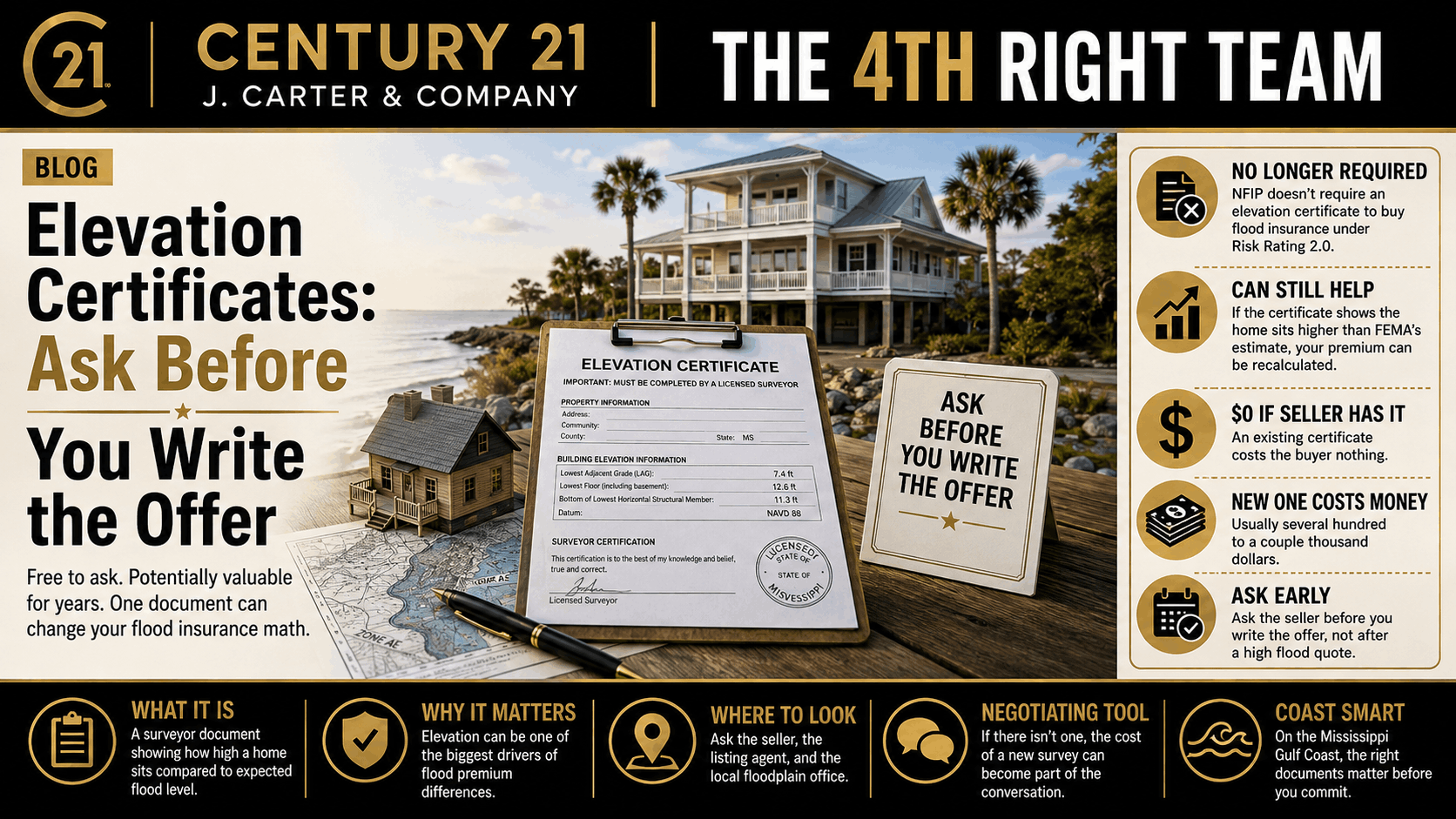
Quick Answer: An elevation certificate is a surveyor's document showing how high your home sits compared to the expected flood level. Since FEMA's Risk Rating 2.0 took effect, you no longer need one to buy an NFIP flood policy. But you can still submit one. If it shows your house sits higher than FEMA's automated estimate, your premium gets recalculated using the better number. A new one runs several hundred to a couple thousand dollars. If the seller already has one, it's free to you. Ask before you write the offer.
That last line is the whole point. An elevation certificate is one of the few things in a real estate deal that costs nothing to ask for and can save you money every year you own the house.
What is an elevation certificate?
It's an official FEMA form completed and signed by a licensed land surveyor, engineer, or architect. It records specific measurements of your building: the lowest floor elevation, the ground elevation next to the house, the lowest mechanical equipment, and the foundation type. Then it compares those numbers to the base flood elevation. That's the height floodwater is expected to reach in a 1% annual chance flood.
In plain terms, it answers one question. How high does this house sit compared to how high the water is expected to get? If you're not sure what zone a home is in, start with what a flood zone designation actually means.
Do you still need an elevation certificate?
No, and this is where most articles on the subject are out of date.
Under Risk Rating 2.0, which FEMA started phasing in during October 2021, an elevation certificate is no longer required to rate or buy an NFIP flood policy. FEMA now pulls its own elevation data from federal LiDAR mapping to estimate a building's height.
Here's the part that matters. FEMA's automated data is an estimate, and estimates can be wrong. If your elevation certificate shows the house sits higher than FEMA assumed, you can submit it and have your premium recalculated using the certificate's data instead.
You submit it if it helps you. You don't if it doesn't. That's a one-way option, and one-way options are worth having.
Certificates are still used elsewhere too. Private flood carriers often want one. Local building departments use them for permits and floodplain rules. And you need one to request a Letter of Map Amendment, the process for getting a property removed from a Special Flood Hazard Area entirely. If that works, your lender's flood insurance requirement can go away.
What can an elevation certificate actually save you?
It depends on the gap between FEMA's estimate and reality, which is why nobody can quote you a number in advance.
What we can say is this. Under Risk Rating 2.0, your flood premium is driven by property-specific factors. Those include elevation compared to the base flood elevation, distance to water, foundation type, and rebuilding cost. Elevation is one of the biggest levers in that formula. That's why two houses on the same street can price very differently.
There's a second discount worth knowing. FEMA's Community Rating System gives premium breaks to communities that go beyond minimum floodplain management standards. Discounts run from 5% to 45% depending on class. Gulfport participates at Class 8, a 10% discount, per FEMA's community status book. Classes change, so check your city's current rating.
A new certificate typically runs several hundred to a couple thousand dollars, depending on the property and the surveyor. That's real money, and it's why finding out the seller already has one is worth a phone call.
Who already has an elevation certificate?
More sellers than you'd think, and most of them have forgotten about it. Homes built or substantially improved in a flood zone after the community joined the NFIP usually got one at permitting. Any home elevated after Katrina almost certainly has one. So does any property where a previous owner filed a map amendment or shopped private flood coverage.
There are three places to look. Ask the seller. Ask the listing agent to check the seller's closing file from when they bought. And call the city or county floodplain administrator, since many keep copies on file. That last one is free and takes one call. Do it before you assume there isn't one.
What does it mean if the seller doesn't have one?
Usually nothing bad. It's a missing document, not a red flag. Plenty of Coast homes never needed one, especially ones that predate current mapping or sit outside a Special Flood Hazard Area. No certificate tells you the seller doesn't have the paperwork. It doesn't tell you the house sits low.
What it does mean is you're buying with less information than you could have. Treat that as two things. First, it's a question for your insurance agent. They can quote flood using FEMA's data and tell you whether a certificate is likely to help, which is one more reason to get the quote before the offer. Second, it's a negotiating item. If the flood quote comes back high and the property sits near a zone boundary or looks elevated, the cost of a survey is fair to put on the table.
What if you're the seller?
Find it before you list. Sellers who show up with a flood determination and an elevation certificate already in hand move faster through underwriting, because the buyer isn't stuck waiting on paperwork mid-contract. It's the same logic as a pre-listing inspection. Documentation you hand a buyer is worth more than reassurance you give them. While you're gathering paperwork, here's what Mississippi sellers must disclose about flooding and storm damage.
By the Numbers
5% to 45%: range of Community Rating System flood premium discounts, depending on a community's class
10%: Gulfport's CRS discount at Class 8, per FEMA's community status book
October 2021: when FEMA began phasing in Risk Rating 2.0
1% annual chance flood: the level the base flood elevation represents
Several hundred to a couple thousand dollars: typical cost of a new elevation certificate
$0: what an existing seller-held elevation certificate costs a buyer
The Bottom Line
Ask for the elevation certificate before you write the offer, not after your flood quote comes back ugly. If the seller has one, it's free information that might lower your premium for as long as you own the house. If they don't, you've learned something worth knowing while you still have room to negotiate. Either way, the question costs nothing. If you're early in the search, our buyer's guide puts the rest of the Coast-specific steps in order. If you're getting ready to list, start with a free home value evaluation.
Frequently Asked Questions
Is an elevation certificate required to buy flood insurance?
No. Under FEMA's Risk Rating 2.0, an elevation certificate is not required to rate or purchase an NFIP policy. FEMA uses its own elevation data. You can still submit a certificate voluntarily if it shows more favorable elevation.
How much does an elevation certificate cost?
Typically several hundred to a couple thousand dollars, depending on the property and the surveyor. If the seller already has one, it costs you nothing.
Will an elevation certificate lower my flood insurance premium?
It can, if it shows your building sits higher than FEMA's automated estimate. If FEMA's data is already accurate or favorable, submitting one won't help. Your insurance agent can tell you whether it's worth pursuing.
Where do I find an existing elevation certificate?
Ask the seller, ask the listing agent to check the seller's closing file, and call your city or county floodplain administrator. Many communities keep copies on file.
What is a Letter of Map Amendment?
It's a FEMA process for correcting a property's flood zone designation. If successful, it can remove a property from a Special Flood Hazard Area and eliminate the lender's flood insurance requirement. An elevation certificate is part of that request.
Sources
FEMA, Risk Rating 2.0 (elevation certificates no longer required for NFIP rating; owners may submit one voluntarily): https://www.fema.gov/flood-insurance/risk-rating
FEMA, Community Rating System (5% to 45% discount range by class): https://fema.gov/flood-insurance/rules-legislation/community-rating-system
FEMA Community Status Book, Mississippi (Gulfport CRS class and discount): check the current list at the FEMA Community Rating System page above
FEMA Flood Map Service Center (flood zones, base flood elevations, map changes): https://msc.fema.gov/portal/home
Keep reading: Flood Zone AE vs. X: What That Letter Actually Costs and Slab, Pier and Beam, or Pilings: What Your Foundation Actually Costs You.
Randy Richardson | Broker Associate
The 4th Right Team | Century 21 J. Carter & Company
Office: (228) 731-3881 | Cell: (228) 547-9999
realtorrandyrichardson@gmail.com
www.The4thRightTeam.com
Looking to SELL or BUY? I know a GUY!