


Blog > Why Property Taxes Jump the Year After You Buy in MS
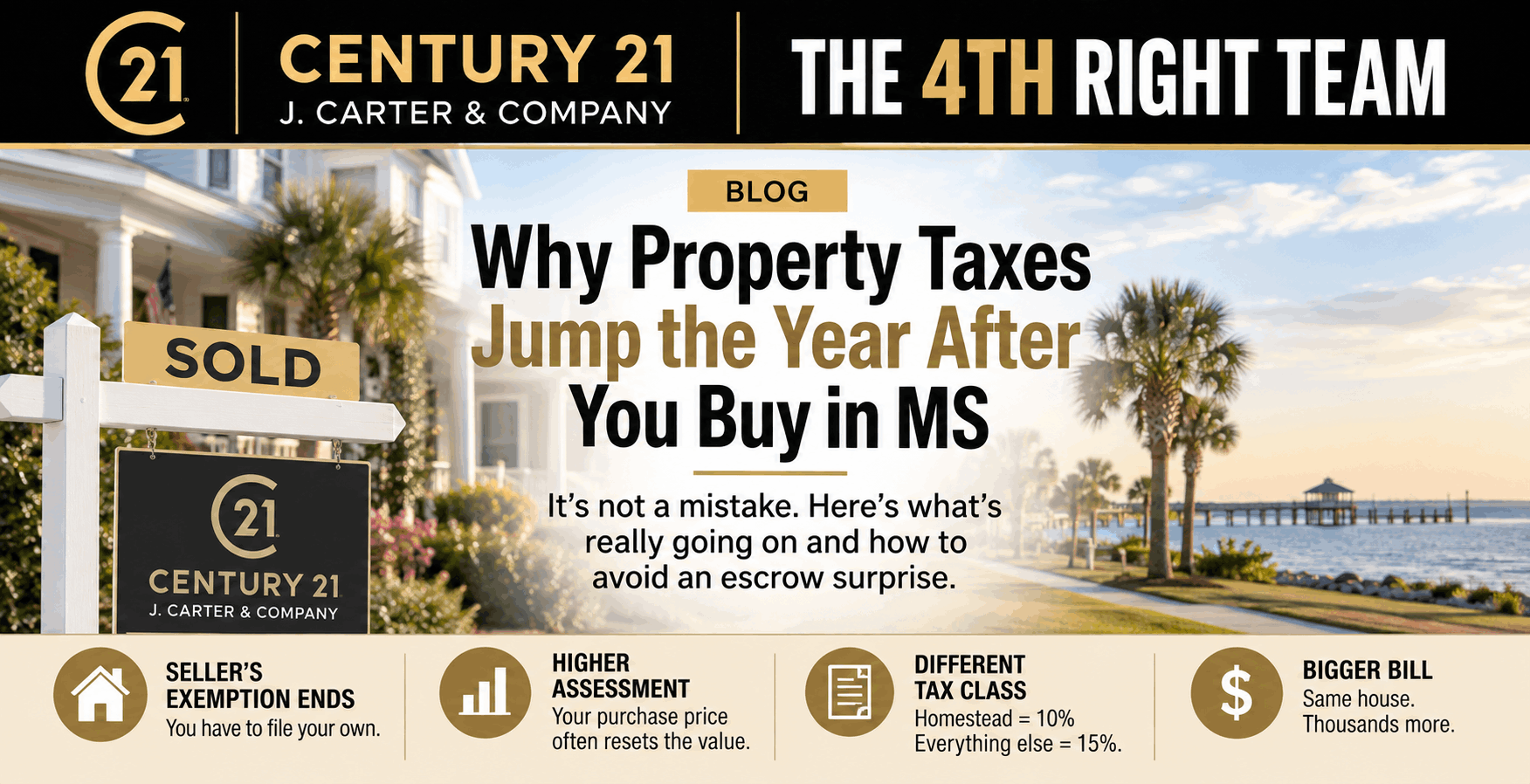
Why Your Property Tax Bill Jumps the Year After You Buy
By Randy Richardson, Broker Associate, The 4th Right Team
Quick Answer: Your first tax bill after closing usually reflects the seller's status, not yours. Mississippi bills taxes a year behind and sets everything by who owned and occupied the home on January 1. The seller's homestead exemption ends with their ownership, and homestead is what keeps a home in the 10 percent Class I assessment ratio instead of the 15 percent Class II ratio. Lose that and the same house gets assessed half again higher, usually on a value the county just updated using your sale price. On a $275,000 Gulfport home, that's roughly $2,100 more a year. Your escrow account comes up short, your lender collects the shortage, and the payment you thought was fixed goes up.
Why does my tax bill go up when nothing about my house changed?
Because the bill isn't about your house. It's about a snapshot.
Mississippi assessors build the tax roll around January 1. Ownership, occupancy, exemptions, and value all get set as of that date. The roll goes to the board of supervisors in July, objections get heard in August, taxing districts set millage rates in September, and bills go out around December 1. Taxes are due by February 1 and start collecting interest the next day.
So if you closed in June, the bill that shows up that December was built off a January 1 picture that still had the seller in it. Their exemption. Their value. Their tax status. You pay it, but it was never your bill. The following December, the roll finally reflects you. That's the one that hurts.
Does the seller's homestead exemption transfer to me?
No. It ends with their ownership, and nobody files a new one for you. Not your closing attorney, not your lender, not me.
You file it yourself at the county tax assessor's office between January 1 and April 1. You have to own and live in the home as of January 1, and your deed has to be recorded with the Chancery Clerk before January 7. Close on December 20 and you can file that January. Close on January 15 and you wait a full year. I wrote a full walkthrough of the filing rules and what each tier is worth in my Mississippi homestead exemption guide.
Here's the part almost nobody explains. Homestead is tied to Class I status, which is single-family, owner-occupied residential property assessed at 10 percent of true value. Everything else is Class II at 15 percent. The homestead application is how the assessor knows you actually live there. Until it's on file, your house can sit in the same class as a rental.
How much does losing the exemption actually cost?
Take a $275,000 home in Gulfport at 131.96 mills. As Class I, the assessed value is $27,500 and the gross bill runs about $3,629. Subtract the $300 homestead credit and you're at roughly $3,329. Run the same house at the Class II ratio and assessed value becomes $41,250, pushing the bill to about $5,443. That's $2,114 more a year, about $176 a month in escrow, on a house that didn't change at all.
The gap moves with your millage rate. Same $275,000 house, same math, and the penalty for not being on the homestead roll runs roughly $1,837 in Biloxi, $2,114 in Gulfport, $2,294 in Ocean Springs, and $2,447 in Pascagoula. Millage gets reset every September, so treat those as this year's snapshot.
One more wrinkle worth knowing. The regular $300 credit only offsets county and school taxes. It does nothing for the city portion of your bill.
Why is the jump worse when you buy from an older owner?
This one catches people, and it's common down here because so many long-held homes are finally trading.
Homeowners who are 65 or older, or totally disabled, get a much better deal than the $300 credit. As of January 1, 2026, the first $12,500 of assessed value comes off the roll entirely, up from $7,500 before House Bill 1255. After the first year that exemption can grow to absorb most future increases in value. Somebody in the same house since the nineties may be paying on a taxable base that stopped tracking the market years ago.
Run it. If that seller's home sat on the roll at $150,000 of true value with the age exemption applied, the bill was around $330. You buy it for $275,000, file your homestead, and you're at about $3,329. If you don't file, you're at $5,443. That's ten times what the seller paid, and every bit of it is legal.
That protection belonged to the person, not to the house. When you're looking at a listing where the taxes look impossibly low, that's usually why.
What if I'm buying new construction?
Then expect the biggest swing of all. In Mississippi, a newly built home stays off the tax roll until it's first sold, rented, leased, or occupied. So the parcel your builder was carrying may have been taxed as a lot at the Class II ratio and nothing more.
A $45,000 lot in Gulfport carries a bill around $891. That finished $325,000 house, once it lands on the roll with your homestead filed, runs closer to $3,989. If your lender built your escrow off the builder's last tax bill, you're going to feel it.
Mississippi doesn't send a supplemental mid-year bill the way some states do. A few national sites claim otherwise, and they're wrong. The correction shows up on the next roll, which means the surprise arrives later and lands all at once.
Why does my mortgage payment go up twice?
Escrow math. Your servicer collects one twelfth of the expected tax bill every month, plus a small cushion. When the real bill comes in higher than the estimate, the account goes negative.
At the annual escrow analysis you get hit from both sides. The shortage gets spread across the next twelve months, and the monthly escrow payment resets higher to cover the new full bill. Then the following year the shortage repayment falls off and the payment drops a little. That's why year two feels like a spike and year three settles. The same thing happens with an underestimated insurance premium, which is why both belong in your budget before you write the offer.
By the Numbers
Class I assessment ratio for owner-occupied homes: 10 percent of true value
Class II ratio for everything else: 15 percent
Regular homestead credit: up to $300, maxing out at $7,351 in assessed value
Age 65 or totally disabled exemption: first $12,500 of assessed value as of January 1, 2026, worth roughly $1,400 to $1,950 a year at Coast millage rates
Filing window: January 1 through April 1
Deed recording cutoff: January 7
Objection deadline if you think the value is wrong: the board of supervisors meeting on the first Monday in August
Tax bills mailed: around December 1. Due: February 1
Cost of not being on the homestead roll, $275,000 home: about $1,837 Biloxi, $2,114 Gulfport, $2,294 Ocean Springs, $2,447 Pascagoula
What should I actually do about it?
Don't trust the tax figure in the listing. Pull the parcel on the county assessor's site and check whether the current bill shows a homestead exemption and which tier. If the seller is 65 or older, assume your bill will be much higher and price it into your monthly number, not just your closing costs.
Then ask your lender to escrow off your own estimate instead of the seller's bill. Take your purchase price, multiply by ten percent, multiply by your district's millage, divide by a thousand, subtract $300. Fund escrow to that number and you'll skip the shortage entirely.
Put a reminder on your calendar for the first week of January. Filing homestead takes about thirty minutes and it's the difference between the two numbers in this article. And if the assessed value itself looks wrong after your first full year, rolls open in July and objections go to the board of supervisors at the August meeting.
The Bottom Line
The bill that jumps in year two isn't a mistake and it isn't a reassessment penalty for buying. It's the roll catching up to reality after a year of running on the seller's status. If you file homestead in your first January and budget your escrow off your own purchase price instead of somebody else's tax bill, most of the shock disappears. The part you can't avoid, the ten to fifteen percent ratio and the loss of a senior exemption, you can at least see coming. If you're still shopping, our buyer's guide covers the rest of what changes your real monthly cost here.
Frequently Asked Questions
Why did my property taxes go up so much the year after I bought my house in Mississippi?
Your first bill was calculated from the January 1 roll, which still reflected the seller's homestead exemption, tax status, and often an older assessed value. Once the roll updates to your ownership, the exemption is gone unless you filed your own, and the value typically reflects your purchase price.
Does the previous owner's homestead exemption carry over to the buyer?
No. Homestead exemption ends with the seller's ownership. The buyer has to file a new application in person at the county tax assessor's office between January 1 and April 1, and must own and occupy the home as of January 1 with the deed recorded before January 7.
What is the difference between Class I and Class II property in Mississippi?
Class I is single-family, owner-occupied residential property, assessed at 10 percent of true value. Class II is all other real property, assessed at 15 percent. The homestead exemption is applied to Class I property, so a home that isn't on the homestead roll can be assessed at the higher ratio.
How much more do you pay without a homestead exemption on the Mississippi Gulf Coast?
On a $275,000 home in Gulfport at 131.96 mills, the difference between a homesteaded bill and a non-homesteaded bill is roughly $2,114 a year, about $176 a month in escrow. The gap runs from about $1,837 in Biloxi to $2,447 in Pascagoula at current millage rates.
Why are property taxes so low on a house owned by an older couple?
Mississippi homeowners who are 65 or older or totally disabled are exempt from tax on the first $12,500 of assessed value as of January 1, 2026, and after the first year that exemption can grow to cover most future increases in value. That benefit belongs to the owner, not the property, so it disappears when the home sells.
Will my mortgage payment change after the tax bill goes up?
Yes, if you escrow. Your servicer spreads the escrow shortage over the following twelve months and raises the monthly escrow amount to cover the higher bill. The payment usually drops slightly a year later once the shortage is repaid.
Sources
Mississippi Department of Revenue, Homestead Exemption — exemption tiers, eligibility, and the January 1 to April 1 filing window
Mississippi House Bill 1255 — increase of the age 65+ and totally disabled exemption from $7,500 to $12,500 of assessed value, effective January 1, 2026
[ADD SOURCE: Mississippi Class I and Class II assessment ratios]
[ADD SOURCE: tax roll calendar — July roll delivery, first Monday in August objections, September millage setting, December 1 billing, February 1 due date]
[ADD SOURCE: the $300 credit offsetting county and school taxes but not the city portion]
[ADD SOURCE: new construction staying off the roll until first sold, rented, leased, or occupied]
[ADD SOURCE: 2026 combined millage rates for Biloxi, Gulfport, Ocean Springs, and Pascagoula]
[ADD LINK: your Mississippi homestead exemption guide, referenced in the body]
About the author. Randy Richardson is a Broker Associate and Team Leader of The 4th Right Team at CENTURY 21 J. Carter & Company. He serves buyers and sellers across the Mississippi Gulf Coast, from Bay St. Louis to Pascagoula, and writes about the local details that change what a home actually costs to own.
Randy Richardson | Broker Associate
The 4th Right Team | Century 21 J. Carter & Company
📞 Office: (228) 731-3881 | Cell: (228) 547-9999
📧 realtorrandyrichardson@gmail.com
🌐 www.The4thRightTeam.com
Looking to SELL or BUY? I know a GUY!