


Blog > Downsizing on the MS Gulf Coast: What 55+ Sellers Need to Know in 2026
By Randy Richardson, Broker Associate, The 4th Right Team at Century 21 J. Carter & Company.
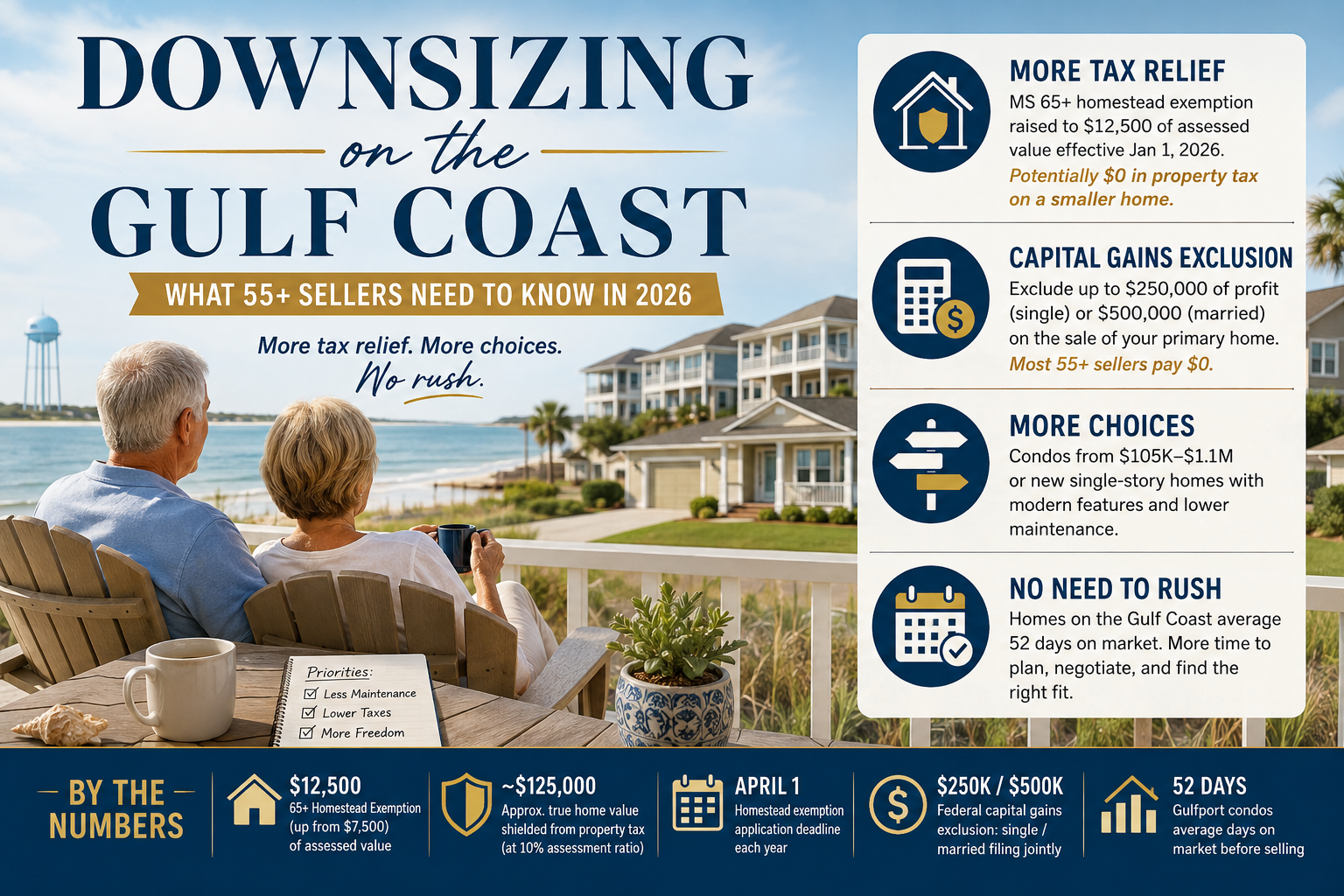
Quick Answer: Downsizing on the Gulf Coast comes with real tax relief this year, and the biggest piece kicks in at 65. Mississippi raised its homestead exemption for homeowners 65 and older, or 100% totally disabled, from $7,500 to $12,500 of assessed value starting January 1, 2026, which can wipe out property tax entirely on a smaller home. Most sellers also won't owe federal capital gains tax, since the exclusion covers up to $250,000 in profit single, $500,000 married. With homes selling slower right now, there's no need to rush.
Should You Sell First or Buy First When You're Downsizing?
There's no single right answer, but the current market changes the math. Homes on the coast are sitting longer than they did a couple years ago, so buying first and carrying two properties for a while is riskier than it used to be. That same slower pace means less pressure to grab the first smaller home you see once you do sell, though. A lot of downsizers land on selling first with a rent-back agreement, which lets you stay put for a set number of weeks after closing while you shop without a deadline hanging over you. If you have significant equity, a HELOC can also bridge the gap so you're not forced into a rushed purchase.
Does Downsizing on the Coast Actually Save You Money on Taxes?
Yes, more than most people realize. Mississippi homeowners 65 and older, or 100% totally disabled, now get a homestead exemption on the first $12,500 of assessed value, up from $7,500 before 2026. The change came from House Bill 1255 and took effect January 1, 2026. At the state's 10% assessment ratio, that shields roughly the first $125,000 of your home's true value from property tax entirely.
If you downsize into a smaller, lower-priced home, there's a real chance your new place falls under that threshold and you stop paying ad valorem property tax altogether. You do have to apply through your county tax assessor's office between January 1 and April 1, and if you're turning 65 this year, you'll need to reapply to move into the higher exemption tier. It doesn't happen automatically, and people lose years of savings by assuming it does.
One note if you go looking. The Department of Revenue's own homestead page has been slow to update and may still show the older $7,500 figure for the age and disability tier. Confirm the current number with your county assessor.
Will You Owe Capital Gains Tax When You Sell?
Probably not, but it's worth doing the math instead of assuming. The IRS lets you exclude up to $250,000 of profit from the sale of your primary home if you're single, or $500,000 if you're married filing jointly. To qualify, you need to have owned and lived in the home for at least two of the last five years, which describes most longtime Gulf Coast homeowners. If you bought decades ago and your home has appreciated well past those numbers, or if it's a second home rather than your primary residence, that's a conversation worth having with a tax professional before you list. For most sellers downsizing out of a primary residence, though, the exclusion covers the entire gain.
Is a Condo or a Single-Story Home the Better Move?
It depends on how much upkeep you want to keep doing yourself. Condos on the coast currently range widely in price, and monthly dues typically cover exterior maintenance, building insurance, and amenities like a pool, which takes a lot off your plate compared to owning a house outright. New single-story home communities are also going up around Gulfport and Ocean Springs, some built to FORTIFIED Gold standards for better storm resistance and often lower insurance costs down the road. A single-story home gives you more space and a yard without stairs, while a condo trades some of that space for a genuinely lower-maintenance lifestyle. Neither is the "right" choice, it comes down to whether you want a yard at all.
Is Now a Good Time to Downsize, or Should You Wait?
If you're financially ready, there's no strong reason to wait. Buyers currently have more negotiating room on the coast, which sounds like bad news for you as a seller, but it also means you'll have more room to negotiate when you buy your next, smaller place. Waiting for a "better market" on both ends rarely works out the way people expect, since a hotter seller's market for your current home usually means a hotter, more competitive market for whatever you're buying next too. The bigger factor is usually personal readiness, not market timing. If the idea of downsizing has been on your mind for a while, this is a reasonable market to act in, without the frantic pace of a couple years ago.
By the Numbers
Mississippi 65+ and totally disabled homestead exemption: raised from $7,500 to $12,500 of assessed value, effective January 1, 2026 (House Bill 1255)
Approximate true home value shielded from property tax: around $125,000 at the state's 10% assessment ratio
Standard homestead exemption for owner-occupants under 65: a tax credit capped at $300
Homestead exemption filing window: January 1 through April 1 each year
Federal capital gains exclusion on a primary home sale: up to $250,000 single, $500,000 married filing jointly
Ownership and residency test for the exclusion: two of the last five years
Gulfport condo price range: roughly $105,000 to $1,100,000
Gulfport condos: average 52 days on market before selling
The Bottom Line
Downsizing on the Gulf Coast in 2026 comes with more tax relief than most 55+ sellers expect, between the expanded homestead exemption once you hit 65 and the federal capital gains exclusion covering most primary home sales outright. The market isn't rushing anyone right now, which works in your favor on both sides of the transaction. Take the time to run the numbers on your specific home, apply for the exemption on time, and let the timeline be about what fits your life, not what the market is doing. Start with a free home value evaluation, then see how we work with sellers.
Frequently Asked Questions
Do I have to sell my current home before I buy a smaller one?
Not necessarily. Many downsizers sell first with a rent-back agreement to avoid carrying two homes, but a HELOC or bridge financing can let you buy first if you have strong equity in your current home.
How much does the Mississippi senior homestead exemption actually save me?
It exempts the first $12,500 of your home's assessed value from all ad valorem taxes, which is roughly the first $125,000 of true value, and can eliminate your property tax bill entirely if your new, smaller home falls under that amount. You must be 65 or older, or 100% totally disabled, and you have to file with your county.
Will I owe capital gains tax when I sell my home?
Most sellers won't, since the IRS excludes up to $250,000 in profit for single filers and $500,000 for married couples on a primary residence, as long as you owned and lived in it for two of the last five years.
Is a condo cheaper to maintain than a single-story home on the coast?
Usually yes, since condo dues typically cover exterior maintenance, building insurance, and shared amenities, while a single-story home still requires you to handle upkeep yourself, even without stairs to worry about.
Should I wait for the market to improve before I downsize?
Not necessarily. A market that favors buyers works both ways when you're selling one home and buying another, so waiting for a stronger seller's market usually means facing a more competitive buyer's market on your next purchase too.
Sources
Mississippi Department of Revenue — Homestead exemption tiers, eligibility, and the January 1 to April 1 filing window
Mississippi House Bill 1255 — Increase of the age 65+ homestead exemption from $7,500 to $12,500 of assessed value, effective January 1, 2026
Randy Richardson | Broker Associate
The 4th Right Team | Century 21 J. Carter & Company
📞 Office: (228) 731-3881 | Cell: (228) 547-9999
📧 realtorrandyrichardson@gmail.com
🌐 www.The4thRightTeam.com
Looking to SELL or BUY? I know a GUY!