


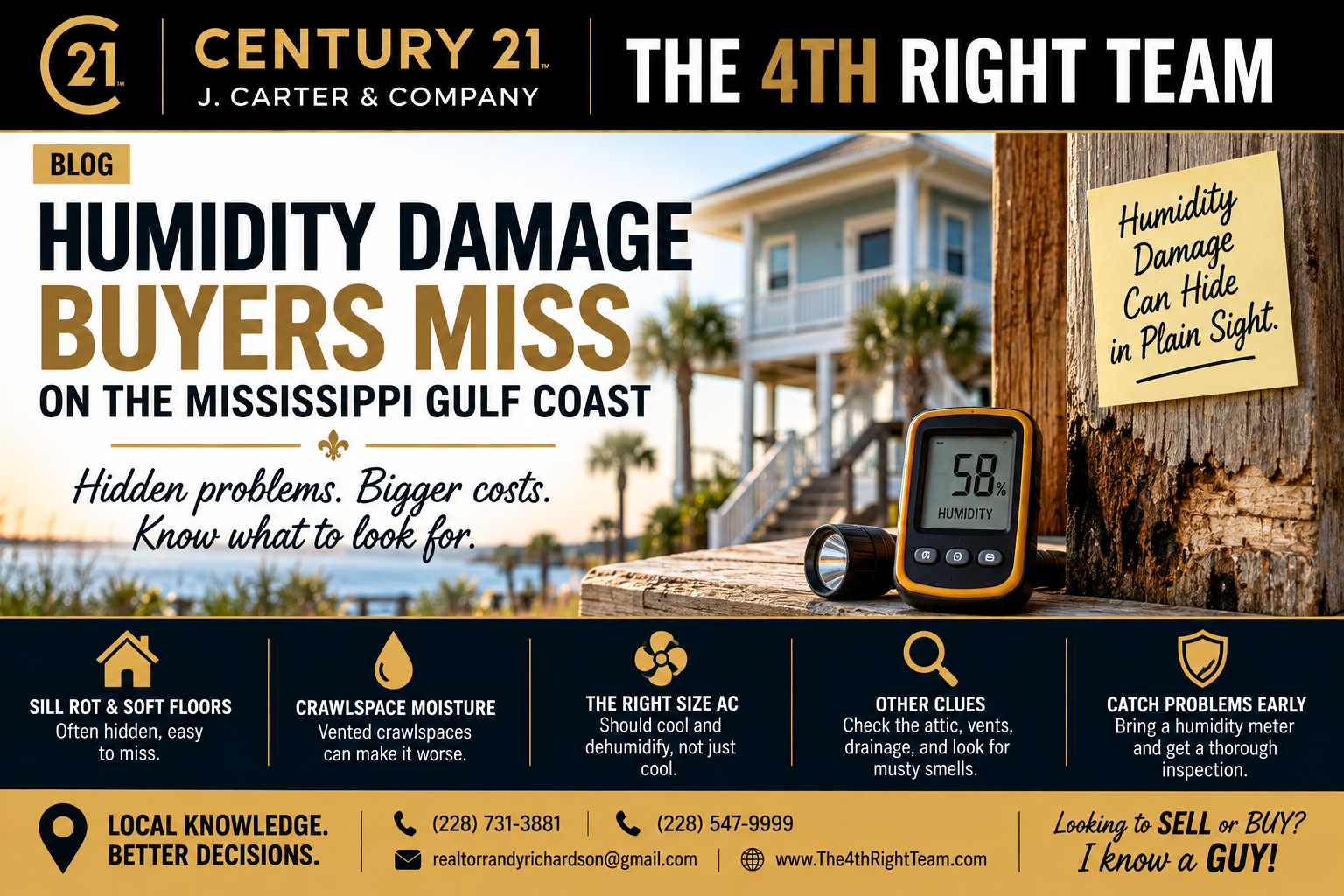
Blog > Humidity Damage Buyers Miss on the Mississippi Gulf Coast
By Randy Richardson, Broker Associate, The 4th Right Team
Quick Answer: The humidity damage buyers miss most on the Mississippi Gulf Coast is slow and hidden. It shows up as rotted sill plates and subfloors, soft spots in the floor, a damp crawlspace, and an air conditioner that cools the house but never dries it out. The EPA recommends keeping indoor humidity below 60 percent, and ideally between 30 and 50 percent. In humid climates, Department of Energy research found closed crawlspaces cut humidity by more than 20 percent compared to vented ones. Bring a cheap humidity meter to showings, and ask your inspector to look hard at the crawlspace, the attic, and the AC.
Storm damage is easy to see. Humidity damage isn't. It builds for years behind baseboards and under floors, and it's usually the thing a new owner finds their first summer in the house. It's the kind of thing a local agent can point out on a showing. Here's what I tell buyers to look for before they're under contract.
Why is humidity damage so common in Gulf Coast homes?
Our air carries moisture most of the year, and moisture is what mold and wood rot need. The EPA says indoor humidity above 60 percent can lead to condensation, and condensation feeds mold. In a warm, humid place like the Coast, the EPA's advice is to dehumidify, not just ventilate.
Air conditioning helps, but it can also create cold surfaces where water condenses, like ductwork, vents, and the underside of floors. Add raised homes, crawlspaces, and houses built decades ago, and you've got plenty of places for moisture to hide. That's one reason an older pre-Katrina home deserves a slower walkthrough.
What does sill rot look like, and how do you find soft floors?
The sill plate is the wood framing that sits right on top of the foundation. When it stays damp, it rots, and so does the subfloor above it. From inside the house, you'll rarely see the rot itself. You'll see the symptoms.
Walk every room slowly. Press your weight near exterior doors, around tubs and toilets, in front of the dishwasher, and near the water heater. A floor that dips, bounces, or feels spongy is a flag. So is hardwood that's cupped, tile with cracked grout in one area, or a baseboard pulling away from the floor.
Pay attention to your nose, too. A musty smell that plug-in air fresheners can't cover usually means moisture somewhere. Damp wood also attracts termites and carpenter ants, according to the Department of Energy, so rot and pest damage often show up together.
What should buyers look for in a crawlspace on the Coast?
Crawlspace vents were supposed to keep things dry. In humid climates, they often do the opposite. Department of Energy research found that outside air here is often wetter than the air under the house. When it flows in, it condenses on cool framing and ductwork.
Ask your inspector to go all the way in, not just shine a flashlight from the hatch. Standing water, wet or missing plastic on the ground, sagging insulation hanging from the floor, fuzzy growth on the joists, and sweating ducts are all signs of a moisture problem.
Closing and conditioning a crawlspace can fix a lot of this. But on the Coast, check one thing first. If the home is in a flood zone, the foundation may need flood openings, and sealing them can create a problem with flood rules and your flood insurance. The elevation certificate will show what's there. Talk to the local floodplain administrator before anyone seals it up. This matters most on bayou and canal lots.
How can you tell if the air conditioner is the wrong size?
A bigger AC isn't a better AC. ENERGY STAR explains that an oversized unit short-cycles. It cools the house fast and shuts off before it runs long enough to pull moisture out of the air. The house hits the right temperature and still feels clammy.
During a showing, notice how the house feels. Cool but sticky is a clue. So are sweating vents, condensation on windows, and a unit that kicks on and off in short bursts. Look at the data plate on the outside unit for its age, and ask the seller for service records.
If something feels off, ask an HVAC contractor to run a Manual J load calculation during your inspection period. That's the standard way to size a system to a specific house. Have the inspector check the condensate drain line and pan as well, since a clogged drain can leak into ceilings and floors for months before anyone notices. If the system needs replacing soon, budget for it alongside your monthly payment.
What other humidity clues do buyers miss?
Go up into the attic if you can, or look at the inspector's photos. Dark stains on the roof decking or rusty nail tips can mean moisture is getting trapped. That also ties into roof age and how insurable the house is.
Check that bathroom exhaust fans actually vent outside, not into the attic. The EPA recommends venting moisture-producing appliances, like clothes dryers, to the outside. Look for fresh paint on just one patch of ceiling. It can mean a stain was covered. And notice if dehumidifiers are running in closets during a showing. They aren't a problem by themselves, but they're a reason to ask questions.
Outside, the ground should slope away from the house. Clogged gutters and water pooling next to the foundation keep the crawlspace and sill plates wet.
What should buyers do if the inspection finds humidity damage?
Don't panic, and don't guess at the cost. Get quotes from a contractor, HVAC company, or crawlspace specialist while you're still in your inspection period. Then decide whether to ask for a repair, a lower price, or a repair credit. In a slower market, buyers usually have more room to negotiate on problems like these.
Don't count on insurance to fix it later. Homeowners policies usually don't cover damage from gradual leaks, mold, or rot unless it comes from a sudden covered event. That's why these repairs belong in your negotiation, not your future claim file. While you're in that inspection window, it's also smart to bind during the inspection period once you're comfortable with the house.
Serious rot can affect more than your budget. If it reaches the framing, it can show up on the appraisal as a structural issue the lender wants fixed before closing.
By the Numbers
EPA recommended maximum indoor humidity: below 60 percent
EPA ideal indoor humidity range: 30 to 50 percent
Typical cost of a humidity meter, per the EPA: $10 to $50
Humidity reduction from closed crawlspaces vs. vented, per DOE Building America research: more than 20 percent
Heating and cooling energy savings from closed crawlspaces in that research: 15 to 18 percent
The Bottom Line
On the Coast, the house that looks perfect in May can smell musty by August. Walk the floors, go into the crawlspace, pay attention to how the AC feels, and bring a humidity meter. The problems you catch before closing are negotiable. The ones you find after are yours. When you're ready to start looking, my buyer's guide walks you through the whole process.
Frequently Asked Questions
What humidity level is too high inside a house?
The EPA recommends keeping indoor humidity below 60 percent, and ideally between 30 and 50 percent. Levels above 60 percent can lead to condensation and mold growth.
Should a crawlspace be vented or sealed on the Mississippi Gulf Coast?
Department of Energy research found closed, conditioned crawlspaces perform better than vented ones in humid climates. But homes in flood zones may need flood openings, so talk to a crawlspace professional and the local floodplain administrator before sealing one.
How do I know if an air conditioner is too big for the house?
An oversized unit turns on and off in short bursts and leaves the house cool but clammy. An HVAC contractor can run a Manual J load calculation to check whether the system fits the house.
Does homeowners insurance cover rot or mold from humidity?
Usually not. Homeowners policies generally exclude damage from gradual leaks, mold, and rot unless it comes from a sudden covered event. Check the policy details with your insurance agent.
Sources
U.S. EPA, A Brief Guide to Mold, Moisture and Your Home. Indoor humidity targets, humidity meter cost, venting appliances: https://www.epa.gov/mold/brief-guide-mold-moisture-and-your-home
U.S. EPA, Mold Course Chapter 9. Dehumidifying in warm, humid climates and condensation above 60 percent humidity: https://www.epa.gov/mold/mold-course-chapter-9
U.S. Department of Energy, Unvented, Conditioned Crawlspaces, Building America Top Innovation. Humid climate crawlspace findings, humidity and energy results, termites and carpenter ants: https://www.energy.gov/eere/buildings/articles/unvented-conditioned-crawlspaces-building-america-top-innovation
ENERGY STAR, Right-Sized Air Conditioners. Short-cycling and humidity control: https://www.energystar.gov/ia/home_improvement/home_sealing/RightSized_AirCondFS_2005.pdf
Washington State Office of the Insurance Commissioner, Leaks, Water Damage and Mold. General homeowners policy treatment of gradual leaks, mold, and rot: https://www.insurance.wa.gov/insurance-resources/home-insurance/how-home-insurance-works/leaks-water-damage-and-mold
About the Author
I'm Randy Richardson, Broker Associate and Team Leader of The 4th Right Team at CENTURY 21 J. Carter & Company. I help buyers and sellers across the Mississippi Gulf Coast make smart moves, from the first showing to the closing table.
Randy Richardson | Broker Associate
The 4th Right Team | Century 21 J. Carter & Company
📞 Office: (228) 731-3881 | Cell: (228) 547-9999
📧 realtorrandyrichardson@gmail.com
🌐 www.The4thRightTeam.com
Looking to SELL or BUY? I know a GUY!