


Blog > Pre-Katrina Home or Post-2005 Rebuild: Which Is Better?
By Randy Richardson, Broker Associate, The 4th Right Team at Century 21 J. Carter & Company.
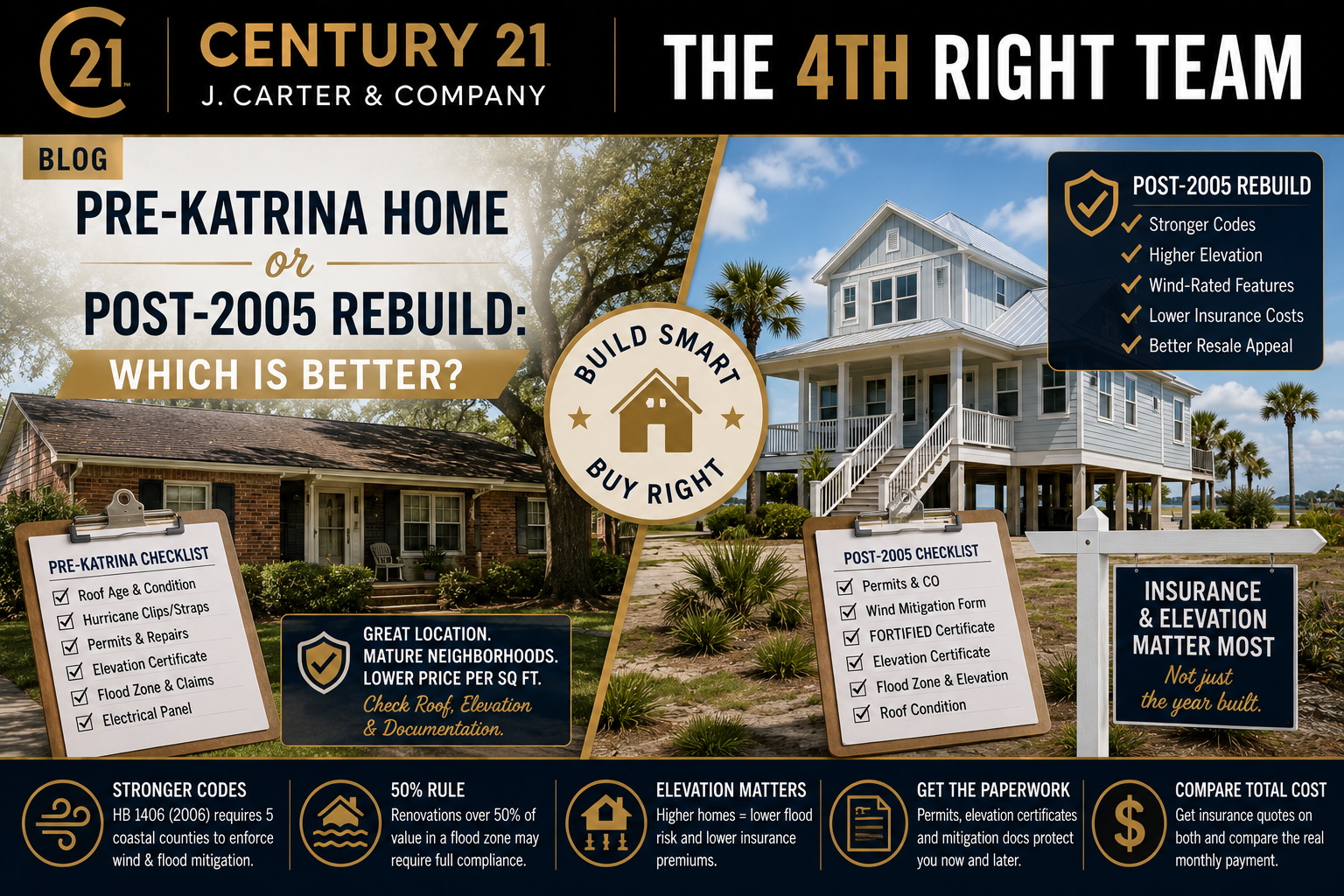
Quick Answer: Building codes on the Mississippi Gulf Coast changed hard after 2005. House Bill 1406 required five coastal counties, Hancock, Harrison, Jackson, Pearl River and Stone, to enforce wind and flood mitigation requirements they can't opt out of. Post-2005 homes generally have stronger roof connections, wind-rated openings and higher floor elevations, which usually means better insurance rates. But that doesn't automatically make the older house the worse buy. Elevation, roof condition and documentation matter more than the year on the tax record.
I've sold here long enough to watch both sides play out. Some of the best deals I've put together were 1960s houses on high ground. Some of the ugliest surprises came from newer homes people assumed were bulletproof.
What actually changed after Katrina?
Mississippi has no blanket mandatory statewide building code. The state runs on home rule, and cities and counties decide what to adopt.
The Coast is the exception. In 2006 the Legislature passed House Bill 1406, requiring Hancock, Harrison, Jackson, Pearl River and Stone counties to enforce the wind and flood mitigation requirements of the 2003 IBC and IRC. Those five can't opt out. The same session created the Mississippi Building Codes Council. Gulfport, Biloxi and Pass Christian later adopted their own IBC and IRC editions with hurricane amendments on top.
One nuance worth knowing: George County is in the wind pool but wasn't part of that 2006 mandate. The insurance map and the code map aren't the same map.
Here's what those rules put into a house. Metal straps and clips at the roof-to-wall connection instead of toenailed framing. A continuous load path tying the roof through the walls to the foundation. Sheathing nailing patterns designed for uplift. Wind-rated windows and doors, or protection for them. On the flood side, higher lowest-floor elevations, flood vents and flood-resistant materials below the base flood elevation.
Design wind speeds here now run roughly 130 to 150 miles per hour or higher depending on location. FEMA also remapped after Katrina and raised base flood elevations across much of the Coast, so newer homes often sit several feet higher than their neighbors.
What should you look at on a pre-Katrina home?
Start with the thing nobody puts in a listing. It's still standing. A house that came through Katrina and everything since is telling you something a spec sheet can't. It's not proof of anything, but it usually means the house sits somewhere sensible.
Then check five things. Roof age and whether it was replaced after 2005. Whether hurricane clips or straps were retrofitted, which a good inspector can often spot in the attic. Window and door ratings, or shutter protection. Electrical panel age and brand. And whether the home has ever been elevated.
Then ask for paper. Permits on post-Katrina repair work are the biggest thing buyers skip, and unpermitted repairs create problems with insurance, appraisals and your own resale later. If a seller rebuilt after a storm and pulled no permits, you need to know before you're under contract. Ask about prior flood claims too, since the seller's disclosure and the CLUE report both show claim history.
What should you look at on a post-2005 rebuild?
Verify it's actually built to the standard you're assuming. "Built in 2008" isn't the same as permitted and inspected under coastal code in 2008, since enforcement varied by jurisdiction in the early years. Ask for permit history and the certificate of occupancy. Get the wind mitigation form if one exists, and the FORTIFIED certificate if the home has one. Both lower a buyer's premium.
Then check the roof anyway. A house built in 2008 has a roof that's eighteen years old now, and roof age drives insurance more than build year does. A newer home with a tired roof can be harder to insure than an older home with a new one.
If the home is elevated, look at how. Pier condition, utilities and ductwork underneath, and breakaway wall construction all matter, and they're easy to miss while you're admiring the view. And don't assume newer means cheaper insurance. It usually helps, but distance from water, elevation and roof age still dominate the quote.
What is the 50% rule, and why should a pre-Katrina buyer care?
This is the one that catches people, and almost nobody explains it before closing.
Under NFIP floodplain rules, if a home sits in a Special Flood Hazard Area and improvements or repairs cost 50% or more of the structure's market value before the work starts, that's a substantial improvement. The entire structure then has to meet current floodplain standards, which can mean elevating the house.
Play that out. You buy a 1970s ranch in a flood zone for $185,000 and plan a $110,000 renovation. If the structure's market value is $150,000, you've tripped the threshold, and the project now includes lifting the house.
The same rule applies to storm damage. If repair costs hit 50% of the structure's value, compliance is triggered whether you wanted a renovation or not. If the home carries NFIP coverage, Increased Cost of Compliance can provide up to $30,000 toward elevating, relocating, demolishing or floodproofing. That helps. It rarely covers it.
Some communities set a stricter threshold than 50%. Before planning any significant renovation on an older Coast home, call the local floodplain administrator and ask what applies at that address.
So which one is the better buy?
Post-2005 rebuilds generally insure better, inspect cleaner and appraise more predictably. Pre-Katrina homes usually cost less per square foot, sit on larger and better-located lots, and live in established neighborhoods with mature trees you can't buy at any price.
The older house is not automatically worse. A well-maintained 1965 home on high ground with a five-year-old roof, retrofitted straps and a documented elevation certificate can insure better than a 2008 house sitting lower and closer to the water. The year on the tax record is a shortcut, not an answer.
So compare them the right way. Get a real insurance quote on both addresses, add taxes, and compare total monthly cost instead of price per square foot. That number tells you which house is the better buy, and it's often not the one you'd guess.
By the Numbers
5 coastal counties required to enforce post-Katrina wind and flood code: Hancock, Harrison, Jackson, Pearl River, Stone
6 counties eligible for the wind pool, which adds George County to that list
2006 the year House Bill 1406 passed and the Mississippi Building Codes Council was created
2003 the IBC and IRC editions whose wind and flood provisions the mandate references
130 to 150+ mph design wind speeds on the Coast
50% of a structure's market value triggers substantial improvement compliance in a flood zone
$30,000 maximum Increased Cost of Compliance benefit under an NFIP policy
The Bottom Line
Post-2005 construction gives you code and insurance advantages that are real and worth paying something for. But plenty of pre-Katrina homes here are excellent buys, and some insure better than newer houses in worse spots. Check the roof, check the elevation, ask for permits, and get insurance quotes on both before you decide. If you're early in the search, our buyer's guide lays out the Coast-specific steps in order.
Frequently Asked Questions
Did Mississippi change building codes after Hurricane Katrina?
Yes. House Bill 1406 in 2006 required Hancock, Harrison, Jackson, Pearl River and Stone counties to enforce wind and flood mitigation requirements from the 2003 IBC and IRC. Those counties cannot opt out, and several Coast cities have since adopted newer code editions with hurricane amendments.
Is a pre-Katrina home harder to insure?
Sometimes, but year built is not the main driver. Roof age, elevation, distance from water and documented mitigation matter more. A pre-Katrina home with a new roof and good elevation can quote better than a newer home in a worse spot.
What is the 50% rule on the Mississippi Gulf Coast?
If a home is in a Special Flood Hazard Area and improvements or repairs cost 50% or more of the structure's pre-work market value, the whole structure must be brought up to current floodplain standards, which can require elevating it.
Should I ask for permits when buying an older Coast home?
Yes. Unpermitted post-storm repair work is common and creates problems with insurance, appraisals and resale. Ask for permit history before your inspection period ends.
Is George County covered by the post-Katrina code mandate?
No. George County is eligible for wind pool coverage but wasn't included in the 2006 building code requirement. The insurance map and the code map cover different sets of counties, which matters if you're counting on local code enforcement for a program or a discount.
Sources
Mississippi House Bill 1406, 2006 Regular Session — Coastal county wind and flood mitigation enforcement requirement
Mississippi Senate Bill 2807, 2006, Building a Safer and Stronger Mississippi Act — Creation of the Mississippi Building Codes Council
FEMA, 44 CFR 59.1 and 60.3, and FEMA P-758 Substantial Improvement/Substantial Damage Desk Reference — The 50% rule and compliance requirements
FEMA National Flood Insurance Program — Increased Cost of Compliance coverage limit
Insurance Institute for Business and Home Safety — Post-Katrina Gulf Coast building code analysis
Randy Richardson | Broker Associate
The 4th Right Team | Century 21 J. Carter & Company
Office: (228) 731-3881 | Cell: (228) 547-9999
realtorrandyrichardson@gmail.com
www.The4thRightTeam.com
Looking to SELL or BUY? I know a GUY!