


Blog > They Found Termites. Here's Why That's Usually Not the Problem You Think It Is
They Found Termites. Here's Why That's Usually Not the Problem You Think It Is
by
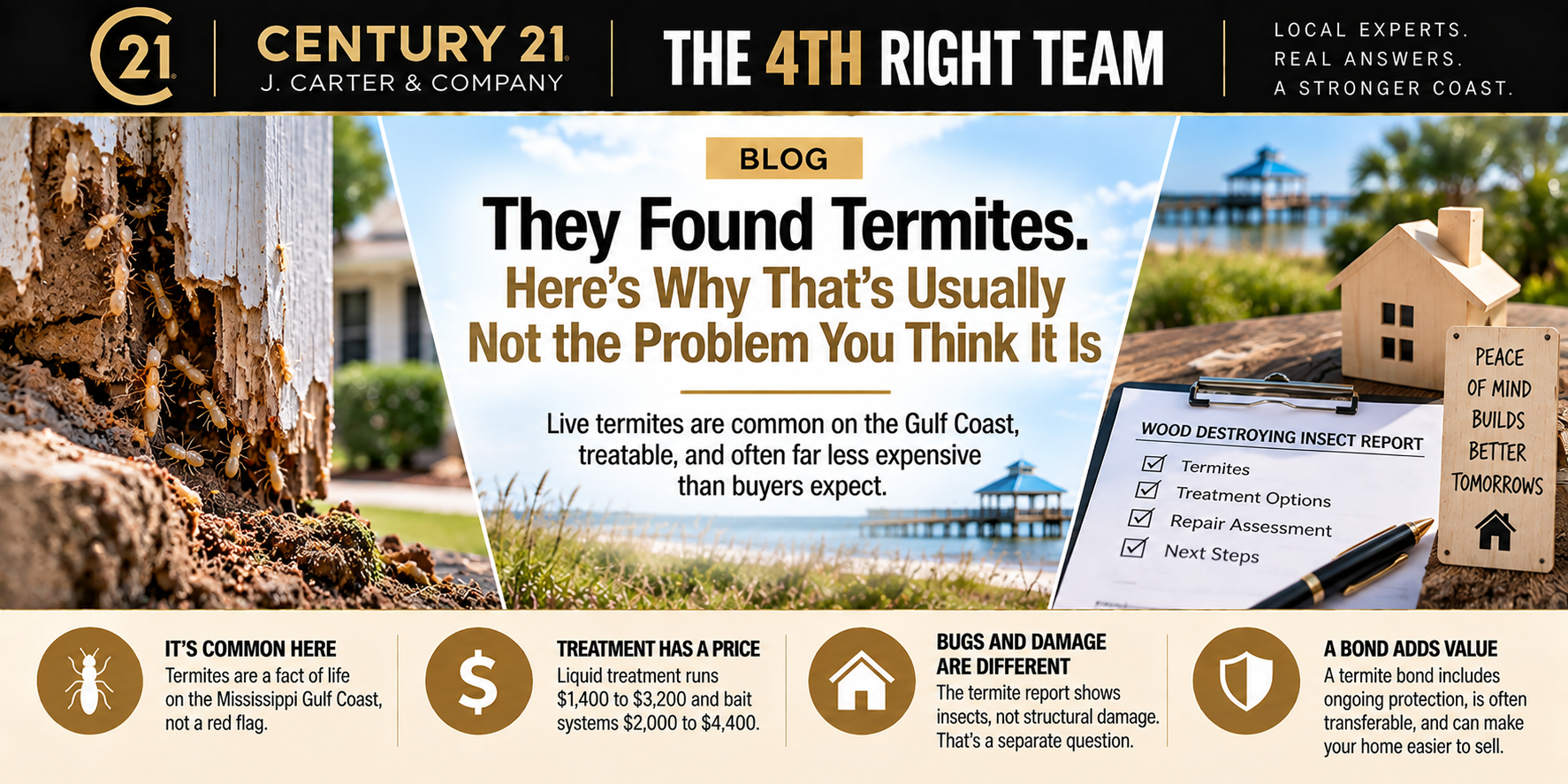
They Found Termites. Here's Why That's Usually Not the Problem You Think It Is
By Randy Richardson, Broker Associate, The 4th Right Team
Quick Answer: A termite report on a Mississippi Gulf Coast home isn't a reason to walk away, and it happens more often than most buyers expect. Live termite activity is a known, priced, treatable problem. Liquid treatment generally runs $1,400 to $3,200 and bait systems $2,000 to $4,400, with an annual bond after that. What you actually need to understand is that the report answers one question and not the other. The Mississippi Official Wood Destroying Insect Report tells you whether insects are present. It says plainly that it is not a structural damage report and that its inspectors are not engineers or builders. Bugs and damage are two separate questions with two separate price tags. Sort out which one you're looking at and the panic goes away.
Termite reports are routine here, not remarkable
Mississippi has heavy termite pressure. Every wood structure in the state is at risk from eastern subterranean termites, according to Mississippi State Extension, and the Gulf Coast counties carry the added weight of Formosan populations on top of that.
So finding evidence on a Coast home is not a sign that something went wrong with the house. It's a sign you live in south Mississippi. Sellers who panic and buyers who bolt are usually reacting to the word rather than to the actual finding.
The inspection itself is cheap and standard. A wood destroying insect inspection runs roughly $75 to $200, and the report is generally good for 30 to 60 days depending on the lender. FHA and VA loans require one, and most conventional Mississippi lenders want one too. It's a normal line item, not a crisis flag.
The two questions, and why people confuse them
This is the part that actually matters, and it's written right on the state's own form.
The Mississippi Official Wood Destroying Insect Report, the form used at closings statewide, says that if activity is reported, some degree of damage should be assumed. It also says that reporting visible damage does not imply the damage should be repaired or replaced. And then it says this outright: the report is not a structural damage report, the inspecting firm's people are not engineers or builders, and you may want to call a qualified engineer or building expert to determine whether structural damage exists and what should be done.
Read that again, because it's doing a lot of work. The pest company tells you about insects. Nobody in that transaction has told you anything about your floor joists.
So when a report comes back with a finding, there are two separate questions:
Are there live termites? That's the pest control question. It has a known answer and a known price. Treat it, bond it, move on.
Is there structural damage? That's a different professional, a different inspection, and a completely different range of money. Most of the time the answer is minor or nothing. Occasionally it isn't, and you want to know which before you close, not after.
Buyers who conflate those two questions either panic over a treatable bug problem or wave off a real repair. Separating them is the whole skill.
What treatment actually costs
Here's the reassuring part, and it's genuinely reassuring.
Liquid barrier treatment in Mississippi generally runs about $1,400 to $3,200. Bait system installation runs about $2,000 to $4,400. Tent fumigation, which is reserved for severe or whole-structure situations and mostly for drywood termites, runs about $2,000 to $5,500. Annual bond renewal on the Coast runs roughly $250 to $650 a year, higher than the national range because of Formosan pressure.
Against a $250,000 house, a $2,500 treatment is a negotiation, not a deal breaker. It's the same size problem as a water heater and a couple of appliances. I've watched buyers walk from a house they loved over a number they'd have absorbed without blinking if it had been attached to any other repair.
And treatment is negotiable like anything else. Seller pays, buyer pays, or it comes out as a repair credit at closing. Talk to your lender about how they want it handled, because on a government-backed loan the treatment usually has to be completed and documented before funding.
The bond is the part people undervalue
A termite bond is a contract with a licensed operator that includes periodic inspections and retreatment if termites come back. Some include damage repair coverage. They're transferable to a new owner.
That transferability is worth real money in a transaction and almost nobody markets it. A house with a current, transferable bond and clean inspection history is a materially easier house to sell than the identical house without one. It answers the question before the buyer asks it.
Here's the piece that makes the bond matter more than people realize: homeowners insurance does not cover termite damage. Not the standard policy, not the wind endorsement, not flood. It's excluded, and the repair bill is entirely yours. That's not a Coast quirk, that's how the policies are written everywhere, and it's worth knowing alongside everything else you're already paying to insure down here.
So the bond is the only thing standing between you and a repair bill nobody else is going to pay. At $250 to $650 a year against structural repairs that average $3,000 to $8,000 and can run well past $15,000 in severe cases, that math isn't close.
The one finding I'd slow down for
I'd be doing you a disservice if I said every termite finding is the same, because Formosans aren't.
Mississippi State Extension explains why. Formosan subterranean termites build carton nests out of saliva, mud, and digested wood inside wall voids, and in humid air those nests hold enough moisture to sustain a colony with no soil contact at all. Extension states directly that this renders traditional soil termite treatments ineffective against them.
That doesn't make a Formosan finding a reason to walk. It makes it a reason to get a treatment plan from an operator who has actually dealt with them, rather than assuming a standard perimeter treatment solves it. Formosan colonies are also much larger and consume more wood faster than native termites, so the structural question deserves more attention.
Practically: if the report says Formosan, ask two things. What's the specific treatment approach given the carton nest issue, and does anybody need to look at the structure. Then price it. It's still a solvable problem. It's just not the same conversation as native subterranean termites.
How to handle it in a transaction
Order the inspection early, in the first week, alongside the home inspection and the insurance quote. Not because termites are urgent, but because the report has a 30 to 60 day shelf life and you don't want to pay for it twice if your closing slips.
If there's a finding, get a written treatment quote before you negotiate anything. A number beats a fear every time. If the report also notes visible damage, get somebody qualified to look at the structure before you agree to a credit, because you're guessing otherwise.
Older homes deserve a closer read. If you're looking at a pre-Katrina home, there's simply been more time for something to have happened and more chance of prior repairs nobody documented.
And sellers, this cuts your way. Getting a bond and a clean report before you list removes a whole category of mid-transaction drama. Unanswered questions are one of the reliable things that make a Coast home harder to sell, and this is a cheap one to answer in advance. Same logic as handling roof age before a buyer raises it.
One legal note. Mississippi generally requires sellers to disclose known material defects. If you know about prior termite damage or a past infestation, that's a conversation with your agent and, if it's significant, with an attorney. I'm a broker, not a lawyer, and this article isn't legal advice.
By the Numbers
$75 to $200 typical cost of a wood destroying insect inspection in Mississippi
30 to 60 days typical validity window for the report, depending on lender
$1,400 to $3,200 typical liquid barrier treatment cost in Mississippi
$2,000 to $4,400 typical bait system installation cost
$2,000 to $5,500 typical tent fumigation cost, reserved for severe cases
$250 to $650 typical annual termite bond on the Mississippi Gulf Coast
$3,000 to $8,000 average structural repair cost when damage is present, with severe cases exceeding $15,000
$0 amount a standard homeowners policy pays toward termite damage
0 engineers or builders on a pest control inspection team, per the state's own report language
MDAC Bureau of Plant Industry the agency that licenses Mississippi pest control operators
The Bottom Line
Termites are a line item, not a verdict. On the Coast they're common enough that treating a finding as a catastrophe means you'll walk away from a lot of good houses.
What separates a calm transaction from a chaotic one is knowing that the pest report and the damage question are two different things. Get the bug question answered by a licensed operator with a written quote. If the report flags visible damage, get the structural question answered by somebody qualified to answer it. Then negotiate a number instead of a fear.
If you're listing and want to take this off the table before a buyer brings it up, start with a home value estimate and look at the selling process. If you're buying, the buyer's guide covers the inspection timeline, you can browse what's listed in Gulfport, and a local agent can tell you whether the number on that quote is reasonable before you react to it.
Frequently Asked Questions
Should I walk away from a house if termites are found?
Usually no. Live termite activity is a treatable, priced problem, with liquid treatment generally running $1,400 to $3,200 in Mississippi. What deserves closer attention is whether structural damage exists, which is a separate question the pest report does not answer.
Does a termite report tell me if the house has structural damage?
No. The Mississippi Official Wood Destroying Insect Report states directly that it is not a structural damage report and that the inspecting firm's inspectors are not engineers or builders. It also advises consulting a qualified engineer or building expert to determine whether structural damage exists.
Who pays for termite treatment in a Mississippi home sale?
It's negotiable. Seller-paid, buyer-paid, or handled as a repair credit at closing are all common. On government-backed loans, treatment typically has to be completed and documented before the lender will fund.
Does homeowners insurance cover termite damage?
No. Termite damage is excluded from standard homeowners policies, and repair costs fall entirely on the owner. That's the main argument for maintaining a termite bond.
What is a termite bond and is it transferable?
A termite bond is a contract with a licensed pest control operator providing periodic inspections and retreatment if termites return, and sometimes damage repair coverage. Bonds are generally transferable to a new owner, which makes a home with a current bond easier to sell.
Are Formosan termites different from regular termites?
Yes, and it matters. Mississippi State Extension reports that Formosan subterranean termites build carton nests in wall voids that retain enough moisture to sustain a colony without soil contact, which renders traditional soil treatments ineffective. Their colonies are larger and consume wood faster. A Formosan finding calls for a treatment plan built around that, not a standard perimeter application.
How long is a Mississippi termite inspection report good for?
Generally 30 to 60 days depending on the lender. Order it early in the contract period so a delayed closing doesn't force a second inspection.
Sources
Mississippi Department of Agriculture and Commerce, Official Wood Destroying Insect Report form and disclosures: https://agnet.mdac.ms.gov/agManage/uploads/1564.pdf
Mississippi Department of Agriculture and Commerce, Bureau of Plant Industry: https://www.mdac.ms.gov/agency-info/bureau-plant-industry/
Mississippi State University Extension Service, Protect Your House from Termites: https://extension.msstate.edu/publications/protect-your-house-termites
Mississippi State University Extension Service, Pest Snapshot: Formosan Subterranean Termite: https://extension.msstate.edu/publications/pest-snapshot-formosan-subterranean-termite-coptotermes-formosanus
Mississippi State University Extension Service, Species of Termites in Mississippi: https://extension.msstate.edu/insects/termites/species-termites-mississippi
TermiteTreatmentPrice.com, Mississippi treatment and bond cost ranges, June 2026: https://termitetreatmentprice.com/termite-treatment-cost-mississippi
PestControlBusinesses.com, termite treatment and structural repair cost ranges, February 2026: https://pestcontrolbusinesses.com/costs/termite-treatment
HomeCostLab, termite treatment cost guide and insurance exclusion, April 2026: https://homecostlab.com/guides/termite-treatment-cost-guide/
Randy Richardson is a Broker Associate and Team Leader of The 4th Right Team at CENTURY 21 J. Carter & Company. He works with buyers and sellers across the Mississippi Gulf Coast, from Bay St. Louis to Pascagoula and north of I-10.
Randy Richardson | Broker Associate
The 4th Right Team | Century 21 J. Carter & Company
Office: (228) 731-3881 | Cell: (228) 547-9999
realtorrandyrichardson@gmail.com
www.The4thRightTeam.com