


Blog > Pre-List Repairs Ranked: Mississippi Gulf Coast Sellers
By Randy Richardson, Broker Associate, The 4th Right Team
Quick Answer: On the Mississippi Gulf Coast, the pre-list repairs that matter most are the ones that can stop a buyer from getting insurance or a loan. The roof comes first, because FHA appraisals require at least two years of remaining roof life and many carriers look hard at roof age. Electrical and plumbing problems come next, since certain older panels and pipe types can make a home hard to insure. Safety items like peeling paint in pre-1978 homes and missing handrails follow, because FHA appraisers flag them. Cosmetic updates come last. They help buyers fall for the house, but they rarely make or break a closing.
Most repair advice you'll find online ranks projects by return on investment. That's useful, but it misses how deals actually die here. On the Coast, a buyer has to insure the house before the loan can close. So I rank pre-list repairs with two questions. Can a buyer get it insured? Will the lender's appraisal flag it?
Which pre-list repairs matter most on the Mississippi Gulf Coast?
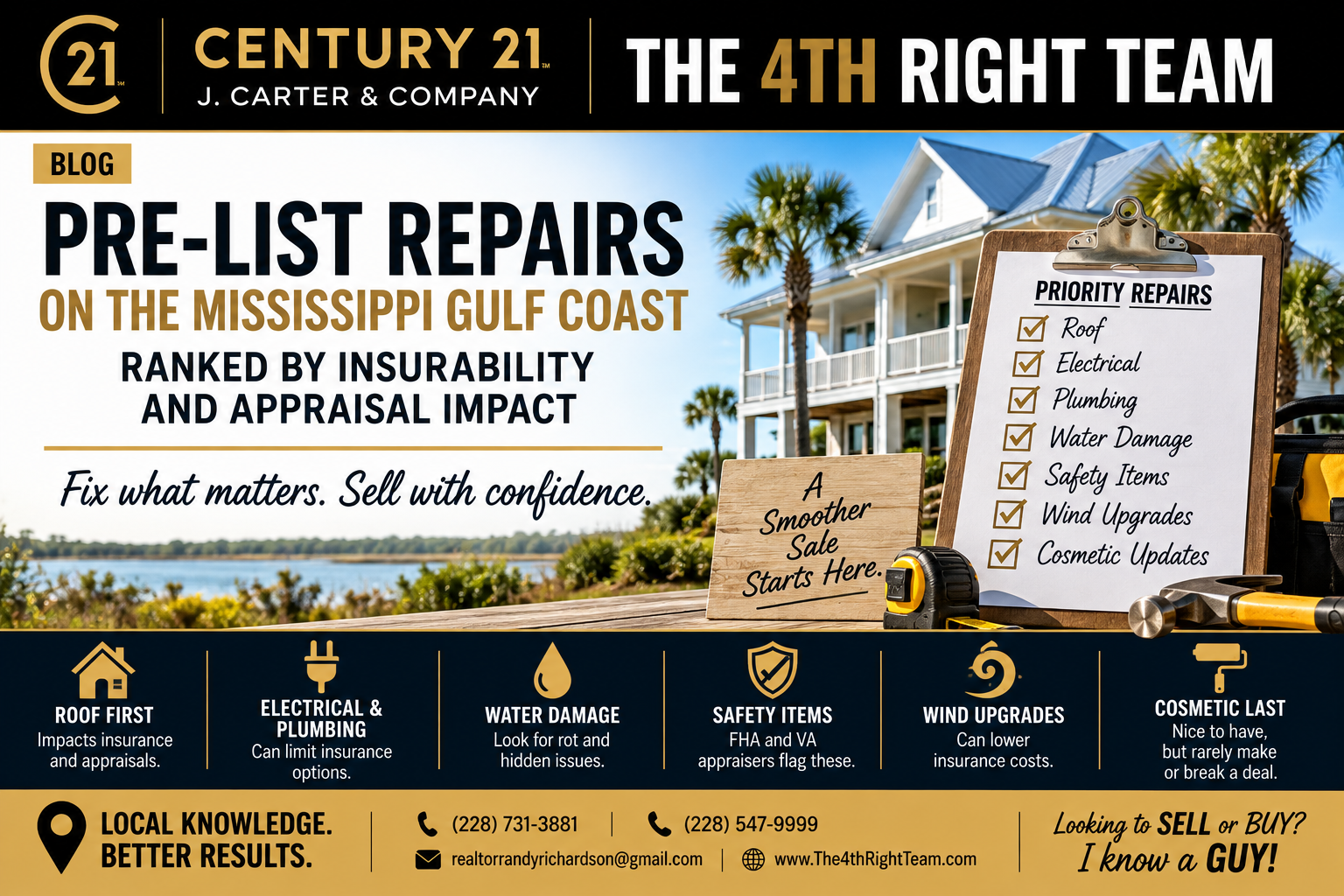
Here's my order. Fix the roof first, then electrical and plumbing hazards, then water damage and rot, then the small safety items an FHA or VA appraiser will catch. Wind upgrades come after that, and cosmetic work comes last.
That order follows the money. A cheap handrail can hold up a loan. An expensive new kitchen can't save a sale if the buyer's insurance agent won't write the roof. Buyers on the Coast now quote the address before they write an offer, so these problems show up early. They can cost you negotiating room, or the buyer altogether.
The best way to find these issues before a buyer does is a pre-listing inspection. It costs far less than a lost deal, and it turns surprises into decisions you get to make on your own timeline.
Why is the roof the number one pre-list repair on the Coast?
The roof hits both tests at once. Insurance carriers on the Coast look closely at roof age and condition, and an older roof can mean fewer carriers willing to write the policy. I explain how that plays out in my post on roof age and insurance.
Appraisals care, too. HUD's FHA handbook says the roof has to keep moisture out and have at least two years of remaining physical life. An active leak or a worn-out roof can turn an FHA appraisal into a "subject to repairs" report, and that can stall a closing.
If your roof is near the end of its life, you've got three choices. Replace it before listing, price the home to reflect it, or offer a repair credit. Replacing it usually opens the house to the most buyers. If you do replace it, ask your roofer about a FORTIFIED roof, which I cover below.
Which electrical and plumbing problems can stop a buyer from getting insurance?
Certain older electrical panels are a red flag for many carriers. Federal Pacific Stab-Lok and Zinsco panels are the names insurance agents mention most often, and some carriers won't write a new policy until the panel is replaced. Exposed wiring and ungrounded outlets can also show up as problems on an inspection.
Plumbing works the same way. Polybutylene supply lines, a gray plastic pipe common in homes from roughly the late 1970s into the 1990s, can limit a buyer's insurance options. So can an old water heater or a history of leaks.
Water damage and wood rot belong in this tier, too. Soft subfloors, rotted sills, and damp crawlspaces aren't just ugly. They can point to structural issues, and Fannie Mae's guidelines say any problem affecting a home's safety, soundness, or structural integrity has to be fixed before a conventional loan can be sold to Fannie Mae. If your house is a pre-Katrina home, have these systems checked before you list.
What repairs will an FHA or VA appraiser flag?
This tier is where small, cheap fixes carry outsized weight. FHA and VA loans have minimum property requirements, and the appraiser checks the house against them. On the Coast, with so many military and first-time buyers, you don't want to shut those buyers out over a small, cheap fix.
For homes built before 1978, HUD requires any chipping or peeling paint to be corrected before an FHA loan closes, because of lead paint risk. Heating, plumbing, and electrical systems have to work. Missing handrails and broken windows are common items appraisers call out, too.
Conventional loans are more forgiving here. Fannie Mae treats things like worn carpet, holes in screens, missing handrails, and cracked glass as minor conditions that don't have to be repaired. But if you fix them anyway, you keep FHA and VA buyers in your pool. That's usually worth a weekend.
Are wind upgrades worth doing before you sell?
Sometimes. A FORTIFIED roof or opening protection doesn't usually move an appraisal much. What it can do is make the house cheaper and easier to insure, and on the Coast that's a selling point buyers feel every month.
If you're replacing the roof anyway, look into Mississippi's Strengthen Mississippi Homes program before you sign with a roofer. Keep your paperwork, including any wind mitigation form from the inspection. Hand it to buyers up front so their insurance agent can quote the home accurately.
If your home is in a flood zone, the same logic applies to your elevation certificate. Have it ready before you list.
Which cosmetic repairs are worth it, and which should you skip?
Cosmetic work is last in my ranking, not worthless. Fresh neutral paint, a clean yard, working light fixtures, and replaced carpet help buyers see the house at its best. They also help a home avoid sitting, and you can read more about what makes a Gulf Coast home harder to sell in 2026.
What I'd skip is a big remodel right before listing. A new kitchen won't fix a roof problem, and appraisers value homes off comparable sales, not what you spent. Put that money into the top tiers first.
One more thing. Fixing a problem doesn't always mean you can leave it off your seller's disclosure. Keep receipts for every repair, and talk with your agent about how to disclose past issues the right way.
By the Numbers
Minimum remaining roof life for an FHA appraisal: 2 years
Year built that triggers FHA defective paint rules: before 1978
Fannie Mae condition rating that makes a home ineligible until repaired: C6
Minimum condition rating after required repairs for Fannie Mae: C5
Repair tiers in my ranking: 6
The Bottom Line
Before you spend a dollar getting ready to sell, ask two questions about every repair. Will it keep a buyer from getting insured? Will an appraiser flag it? Fix those first, and save the cosmetic list for whatever budget is left. If you want to know what your home could sell for as-is versus after repairs, start with a free home evaluation. Then see how I sell homes on the Coast.
Frequently Asked Questions
What repairs should I make before selling my house in Mississippi?
Start with anything that affects insurance or a loan: the roof, problem electrical panels, polybutylene plumbing, water damage, and rot. Then fix small safety items like peeling paint in pre-1978 homes and missing handrails. Cosmetic updates come last.
Will an FHA appraisal fail because of the roof?
It can. HUD requires the roof to keep out moisture and have at least two years of remaining physical life. An active leak or a worn-out roof can lead to required repairs before closing.
Can an old electrical panel keep a buyer from getting homeowners insurance?
Yes. Some carriers won't write a new policy on homes with certain older panels, such as Federal Pacific Stab-Lok or Zinsco. Replacing the panel before listing keeps more buyers able to insure the home.
Is it better to make repairs or offer a credit when selling?
It depends on the repair. Anything that blocks insurance or a loan is usually better fixed before listing. For items buyers can handle after closing, a repair credit can work well.
Sources
Fannie Mae Selling Guide B4-1.3-06, Property Condition and Quality of Construction. Minor conditions, C5 and C6 ratings, safety, soundness, and structural integrity: https://selling-guide.fanniemae.com/sel/b4-1.3-06/property-condition-and-quality-construction-improvements
HUD Handbook 4000.1, FHA Single Family Housing Policy Handbook. Roof covering, mechanical systems, and defective paint requirements: https://www.hud.gov/sites/default/files/OCHCO/documents/40001-hsgh-Update-17.pdf
FHA.com, What Is HUD 4000.1. Summary of minimum property requirements: https://www.fha.com/fha_article?id=4157
Harry Levine Insurance, Why Are Federal Pacific Breakers Uninsurable? Carrier treatment of Federal Pacific, Zinsco, and polybutylene: https://www.harrylevineinsurance.com/federal-pacific-breakers-uninsurable/
About the Author
I'm Randy Richardson, Broker Associate and Team Leader of The 4th Right Team at CENTURY 21 J. Carter & Company. I help buyers and sellers across the Mississippi Gulf Coast make smart moves, from the first showing to the closing table.
Randy Richardson | Broker Associate
The 4th Right Team | Century 21 J. Carter & Company
📞 Office: (228) 731-3881 | Cell: (228) 547-9999
📧 realtorrandyrichardson@gmail.com
🌐 www.The4thRightTeam.com
Looking to SELL or BUY? I know a GUY!