


Blog > Buying a Lot to Build on the Coast: What to Check Before You Close
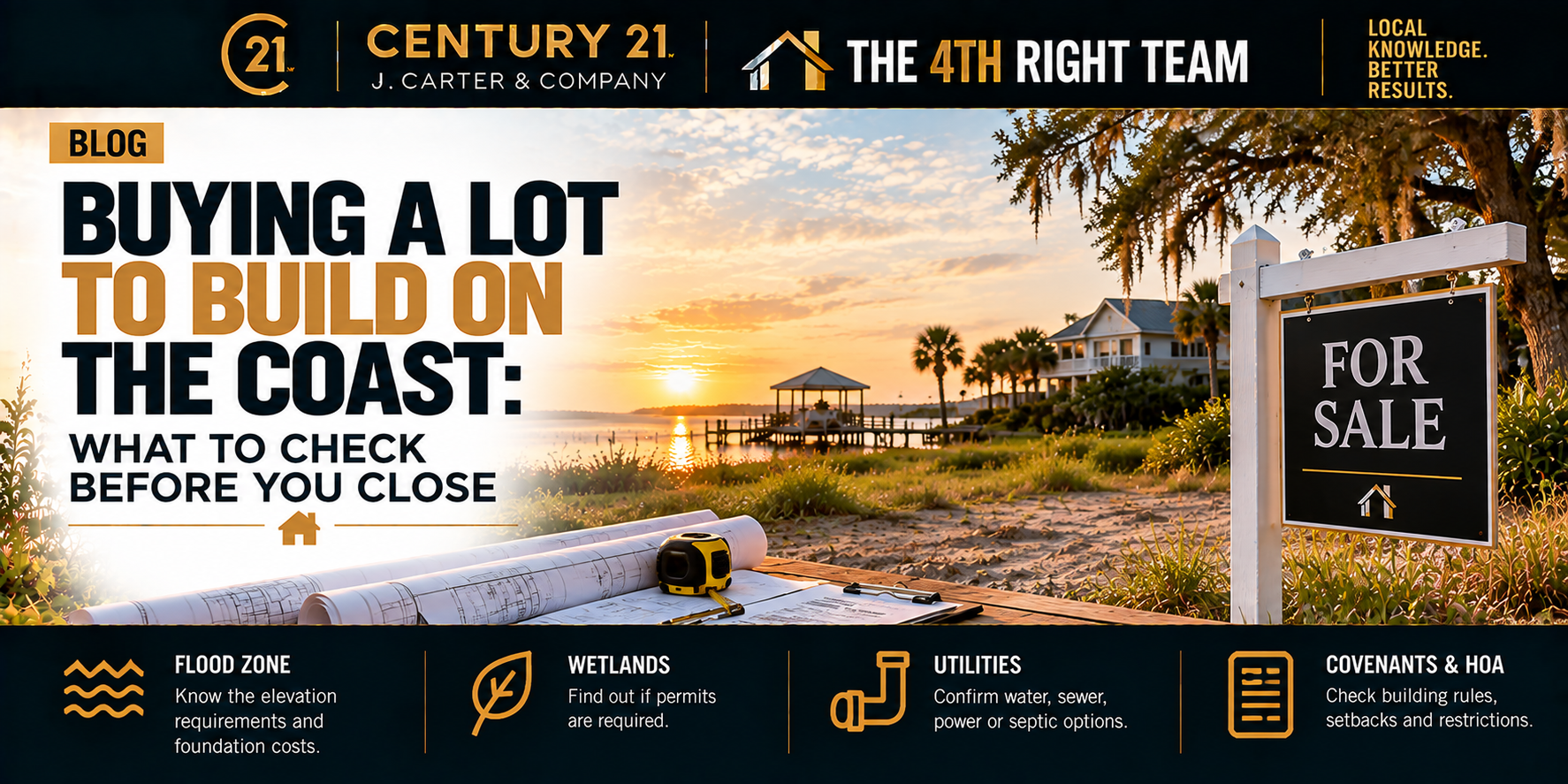
Buying a Lot to Build on the Coast: What to Check Before You Close
By Randy Richardson, Broker Associate, The 4th Right Team
Quick Answer: Before you buy a lot to build on the Mississippi Gulf Coast, check four things: the flood zone and base flood elevation, whether the land holds wetlands, whether it can get sewer or pass a septic evaluation, and what the covenants or HOA allow. The flood elevation sets how high your house has to sit, and in a V zone it requires a pile or column foundation. That can cost far more than the lot saved you. Wetlands in Hancock, Harrison and Jackson counties can require a permit through the Mississippi Department of Marine Resources and the Corps of Engineers. Put all four in your contract as conditions before you close.
A cheap lot is one of the most tempting listings on the Coast. It's also one of the easiest places to lose money. With a house, you can see most of what you're buying. With land, the expensive surprises are under the dirt, in the flood map and in the paperwork.
How does the flood zone affect building on a Coast lot?
It sets the height of your house, and height is money. In a high-risk flood zone, the lowest floor of a new home has to sit at or above the base flood elevation. Jackson County's flood ordinance, updated May 2024, requires exactly that in A zones. In V zones, it requires the bottom of the lowest structural beam to sit at or above that elevation, on pilings or columns.
Some cities and building codes go further and require extra height, called freeboard. So call the floodplain administrator for that specific lot before you buy. Ask what zone it's in, what the base flood elevation is and how high the finished floor will need to be.
Then compare that number to the ground. A lot sitting 4 feet below the required elevation needs a very different foundation than one already sitting above it. Here's how slab, pier and beam, and pilings compare on cost and insurance. If you're not sure what the letters mean, start with what a flood zone designation means.
Jackson County also requires an elevation certificate from a surveyor or engineer before construction, and a FEMA elevation certificate after the house is finished. Budget for both.
Do I need a permit if the lot has wetlands?
Very possibly. The Mississippi Department of Marine Resources handles wetlands permits for the Coastal Zone, which covers Hancock, Harrison and Jackson counties. Applications go through a joint process with the U.S. Army Corps of Engineers, which regulates filling wetlands under the federal Clean Water Act.
That matters because a lot can look dry in October and hold water in March. Low spots, marsh grasses and standing water are all warning signs. So is a price that seems too good for the location.
If you see any of those, hire a wetlands consultant or surveyor during your contract period, and use DMR's permit guidance to see what applies. Filling or clearing without a required permit can bring fines and an order to restore the land, at your cost.
Waterfront lots bring their own checks, including bulkheads, piers and shoreline permits. Here's how the four kinds of Coast waterfront differ.
Can the lot get water, sewer and power?
Ask before you assume. Inside most cities, you'll tie into city water and sewer, but tap and impact fees can add real money. Get the numbers from the utility in writing.
Outside city limits, and in much of the land north of I-10, you'll likely need a septic system and possibly a well. The Mississippi State Department of Health does soil and site evaluations. Its permit or recommendation is required to get a water meter. A lot that fails that evaluation may need a costly engineered system, or it may not be buildable the way you planned.
So make a passing site evaluation a condition of your contract. If you're planning a well, here's what to know about well water testing. And call the power company about how far the nearest line is. Running service down a long, empty road isn't cheap.
What should I check in the covenants, HOA and survey?
Everything that limits what you can build. Many Coast subdivisions have recorded covenants or a property owners association. They can set minimum square footage, approved materials, setbacks, fence rules, whether you can park a boat or RV and even how soon you have to start building.
Read them before you sign, not after. Your closing attorney can pull the recorded restrictions and check for easements, rights of way and access. A lot with no legal road access is a lot you can't easily build on or sell.
Order a current survey too. It shows the true boundaries, easements and whether the neighbor's shed is sitting on your land. On rural acreage in places like Saucier or Kiln, that matters even more.
How do insurance and financing change when you build?
New construction built to current code usually insures better than an older home, especially on wind. But the lot still sets the flood picture, and the foundation you're forced into shapes the premium. Get an insurance agent to price the house you plan to build on that lot before you close. It's the same reason we get the insurance quote before the offer on existing homes.
Financing works differently too. Land loans and construction loans usually have different down payment and approval rules than a regular mortgage. Talk to a lender before you commit, so you know whether you're buying the lot with cash, a land loan or a single construction-to-permanent loan.
By the Numbers
4: checks before closing on a lot (flood elevation, wetlands, septic or sewer, covenants)
3: coastal counties where DMR handles wetlands permits (Hancock, Harrison, Jackson)
At or above: required lowest floor height relative to base flood elevation in A zones under Jackson County's ordinance
2: elevation certificates Jackson County requires, one before and one after construction
May 2024: latest revision of Jackson County's flood damage prevention ordinance
1 permit: MSDH site evaluation needed before you can get a water meter on septic
The Bottom Line
Buying land on the Coast is a great way to get exactly the home you want, but the lot price is only the start. Check the flood elevation, look for wetlands, confirm septic or sewer and read the covenants before you close. Put each one in the contract as a condition. If you're starting your search, our buyer's guide covers the rest, and you can browse land and homes in Vancleave and other north-of-I-10 areas.
Frequently Asked Questions
What should I check before buying land on the Mississippi Gulf Coast?
Check the flood zone and base flood elevation, whether the lot contains wetlands, whether it can connect to sewer or pass a septic evaluation, and what the covenants or HOA allow. Order a survey and confirm legal road access.
Do I need a permit to fill wetlands on my lot in Mississippi?
Often, yes. The Mississippi Department of Marine Resources handles wetlands permits in Hancock, Harrison and Jackson counties, and applications go through a joint process with the U.S. Army Corps of Engineers.
How high do I have to build in a flood zone on the Coast?
At minimum, the lowest floor must sit at or above the base flood elevation in A zones. In V zones, the lowest structural beam must be at or above it, on pilings or columns. Some cities require more, so ask the local floodplain administrator.
Can I put a septic system on any lot in Mississippi?
No. The Mississippi State Department of Health performs soil and site evaluations, and its permit or recommendation is required to get a water meter. Some lots need an engineered system, and some may not work at all.
Sources
Jackson County Flood Damage Prevention Ordinance, amended May 1, 2024: lowest floor elevation in A and V zones, elevation certificates before and after construction
Mississippi Department of Marine Resources, Wetlands Permitting: Coastal Zone permits for Hancock, Harrison and Jackson counties, joint application with the Corps of Engineers
U.S. Army Corps of Engineers, Mobile District, Mississippi Joint Application: federal wetlands permitting in coastal Mississippi
Mississippi State Department of Health, On-Site Wastewater: soil and site evaluations, permit required for a water meter
FEMA Flood Map Service Center: flood zone and base flood elevation lookup
About the Author
Randy Richardson is a Broker Associate and Team Leader of The 4th Right Team at CENTURY 21 J. Carter & Company. He serves buyers and sellers across the Mississippi Gulf Coast.
Randy Richardson | Broker Associate
The 4th Right Team | Century 21 J. Carter & Company
📞 Office: (228) 731-3881 | Cell: (228) 547-9999
📧 realtorrandyrichardson@gmail.com
🌐 www.The4thRightTeam.com
Looking to SELL or BUY? I know a GUY!