


Blog > Slab, Pier and Beam, or Pilings: What Your Foundation Actually Costs You on the Gulf Coast
Slab, Pier and Beam, or Pilings: What Your Foundation Actually Costs You on the Gulf Coast
by
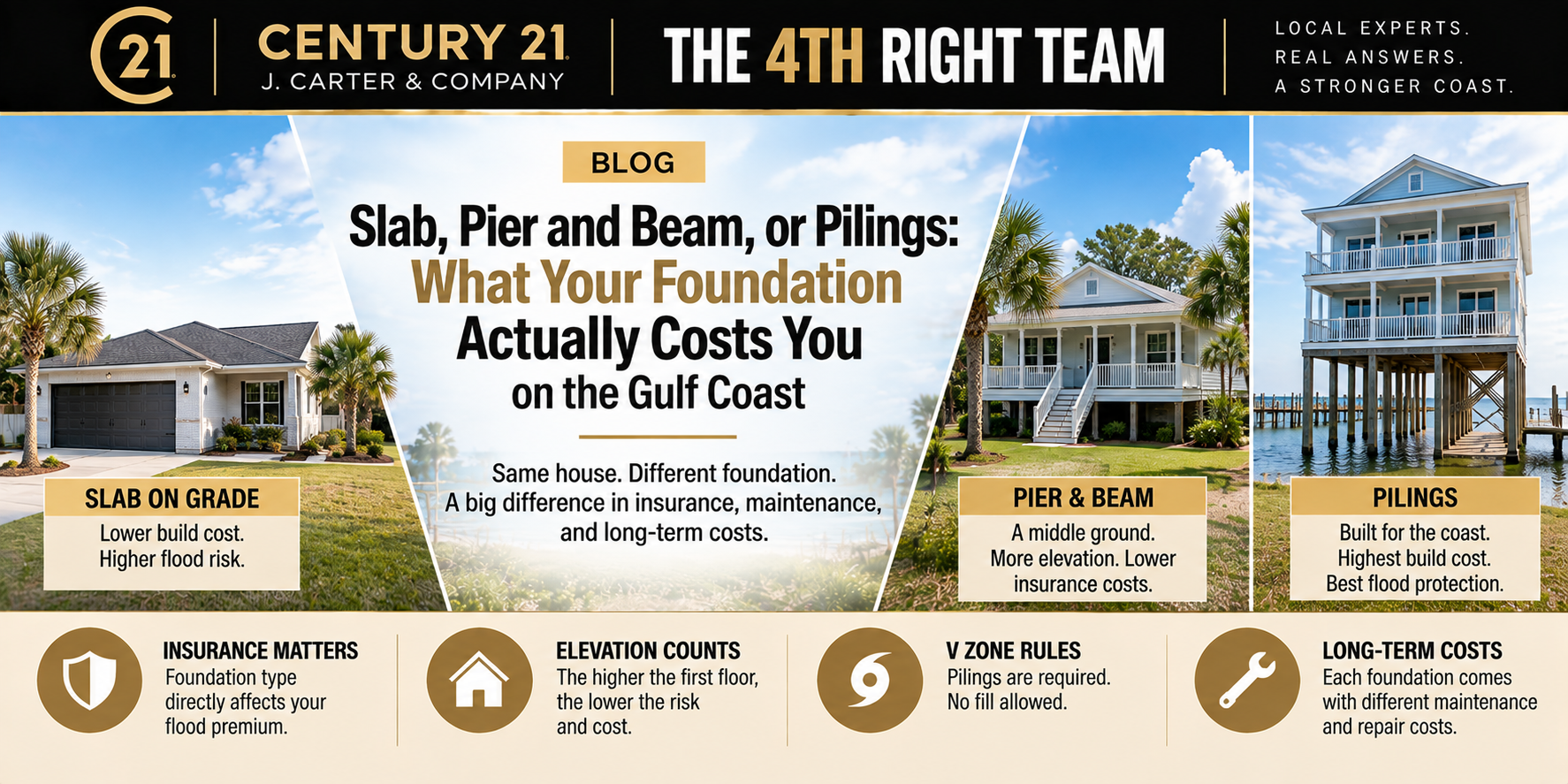
Slab, Pier and Beam, or Pilings: What Your Foundation Actually Costs You on the Gulf Coast
By Randy Richardson, Broker Associate, The 4th Right Team
Quick Answer: On the Mississippi Gulf Coast, the foundation under a house changes your insurance bill more than almost any other feature. FEMA prices flood insurance using six foundation types, not three, and how high your first floor sits above the ground drives a real discount. A crawlspace sitting three feet above grade earns about a 22 percent break compared to the same house sitting flat on the ground. In V and VE zones you don't get a choice at all, because federal rules require an open pile or column foundation and expressly prohibit using fill to raise the building. Slab is cheapest to build and maintain, pilings cost the most and insure the best, and pier and beam sits in between on both.
The three foundations, and why FEMA counts six
Around here, most houses land in one of three camps. Slab on grade means the concrete is poured right on the ground and the house sits on it. Pier and beam, which people also call raised or crawlspace, puts the house on short masonry or concrete piers with a vented crawl underneath. Pilings mean deep posts driven into the ground with the living space lifted well above them, and that's what you see on the beach and along the bayous.
FEMA doesn't use three categories though. Under Risk Rating 2.0, the rating system splits foundations six ways: slab on grade, basement, crawlspace, elevated without enclosure on post or pile or pier, elevated with enclosure on post or pile or pier, and elevated with an enclosure that isn't on posts, piles, or piers.
That last distinction is the one that costs people money. Two houses can both be "on pilings" and rate differently depending on whether the space underneath is left open or walled in. If you're buying an elevated home and somebody framed in the ground level after the fact, that changes your rating category.
Insurance is where the real money is
First floor height is a direct rating variable. The higher your lowest floor sits above the ground, the less you pay. LSU AgCenter's breakdown of the FEMA discount table shows a crawlspace foundation with a first floor height of three feet above grade earning roughly a 22 percent discount compared to the identical house at zero. The discount scales continuously, so every foot counts.
A slab home in a mapped flood zone has almost nothing working in its favor on this. The living space is the lowest floor and it's at grade. A piling home with twelve feet of air underneath is a completely different risk, and it prices like one.
Wind is the other half of the bill, and here the math runs the opposite direction. Getting a house up in the air puts more surface in the wind. That doesn't automatically make wind coverage worse, because construction quality, connectors, and roof shape matter more than height alone, but don't assume elevating solves everything. Remember that wind and hail coverage is usually built into the base homeowners policy on the Coast, that some carriers still exclude it, and that the wind pool is county-wide regardless of how your house is built.
The practical move is the same one I give everybody. Quote the actual address before you write an offer, and get the foundation type and first floor height in front of the agent when you do. If you want a sense of the ranges first, our post on what insurance costs on the Coast lays that out.
In a V zone, you don't pick the foundation
This surprises people shopping close to the water. In coastal high hazard areas, which are the V and VE zones, federal rules require the building to sit on piles or columns. Using structural fill to raise the pad is expressly prohibited, because waves and scour take the fill away during the storm the design is built for.
The elevation is measured differently too. In an A zone you measure to the top of the lowest floor. In a V zone you measure to the bottom of the lowest horizontal structural member, meaning the beam, not the floor. That's a real difference when somebody's reading an elevation certificate and comparing two houses.
The space underneath has rules of its own. It can only be enclosed with open lattice, insect screening, or non-supporting breakaway walls designed to collapse under wave load without taking the house with them. Enclosed areas are limited to parking, access, and storage. And FEMA has long noted that V zone enclosures over 300 square feet can draw higher premiums because of the extra load they put on the foundation in a storm.
There's also a middle category worth knowing. Coastal A zones sit between the V zone line and what FEMA calls the Limit of Moderate Wave Action, where wave heights run between one and a half and three feet. That's enough to do serious damage, and building standards there are stricter than a plain A zone. If you're shopping any kind of waterfront, ask which one you're in.
What each one actually costs to maintain
This part is from watching houses on this coast rather than from a study, so take it as what I see rather than gospel.
Slab is the cheapest to live with until something goes wrong under it. Plumbing runs through the concrete, so a leak means breaking the floor to reach it. Slabs also sit low, which means less clearance from wet ground and more chance of moisture wicking into finishes.
Pier and beam gives you access, and access is worth a lot. A plumber can get under there. So can an inspector. The trade is humidity. In a Gulf Coast crawlspace, moisture is the enemy, and it shows up as soft spots, sill rot, and HVAC that runs hard because the ductwork is sitting in damp air. Vapor barriers, working vents, and drainage that moves water away from the piers are what keep it healthy.
Pilings cost the most to own. Salt air eats metal, so every connector, strap, and fastener matters, and the structure only performs as long as the metal does. You also inherit stairs, an exterior that's harder to reach for painting and repair, and exposed underside utilities. If the ground level was enclosed, verify it was done to code and not just framed in by a previous owner with a nail gun and good intentions.
Termites don't care which one you picked
The idea that a slab keeps termites out is wrong, and on this coast it's expensively wrong.
Mississippi State Extension reports that Formosan subterranean termites, first found in the state in 1984, now occur in at least 26 Mississippi counties and are especially common in the coastal area. What makes them different is the carton nest. They build nests out of saliva, mud, and digested wood in wall voids, and in humid air those nests pull enough moisture to sustain a colony without any soil contact at all. Extension notes plainly that this renders traditional soil termite treatments ineffective. Southeastern drywood termites are less common, but most Mississippi infestations happen in the three coastal counties.
So a slab home isn't safe and an elevated home isn't safe. What actually helps is a real bond, a current wood-destroying insect report, and an inspector who can get eyes on the structure. That last one favors pier and beam and pilings, because you can actually see what you're buying.
Resale: who's your buyer in five years?
Foundation type narrows or widens your buyer pool, and that shows up in days on market.
Elevated homes on pilings sell well to people who want water and understand what comes with it. Look at what moves in places like Pass Christian Isle and you'll see that buyer exists in numbers. But stairs cut both ways, and buyers thinking about aging in place ask about them. If you're downsizing, that's a live question, not a small one.
Slab homes have the widest buyer pool and the least insurance story to tell. If they're in a flood zone, though, the premium becomes the negotiation, and a high premium is one of the things that makes a Coast home harder to sell.
Whatever you own, the single best resale move is documentation. Have the elevation certificate. Have the termite bond and the current report. Have the flood vent photos and receipts if you've got them, and the machinery elevation documentation. Sellers who hand that folder to a buyer's agent close faster than sellers who say they'll look for it. Same logic as roof age: the problem isn't usually the fact, it's finding out about the fact three days before closing.
By the Numbers
6 foundation types FEMA uses to rate flood insurance under Risk Rating 2.0
22.1% flood premium discount for a crawlspace foundation with a first floor height of 3 feet above grade versus 0 feet, per LSU AgCenter
0 amount of structural fill permitted to elevate a building in a V zone
3 ways a V zone under-area may be enclosed: open lattice, insect screening, or non-supporting breakaway walls
300 sq ft V zone enclosure size above which FEMA notes premiums may increase
1.5 to 3 feet wave heights in a Coastal A zone, between the V zone line and the Limit of Moderate Wave Action
1984 year Formosan subterranean termites were first found in Mississippi
26+ Mississippi counties where Formosan termites now occur, per MSU Extension
Bottom of the beam the measuring point for V zone elevation, versus top of the floor in an A zone
The Bottom Line
There isn't a best foundation. There's a best foundation for a specific lot, a specific flood zone, and a specific budget. Close to the water the decision is already made for you by federal rule. Farther inland it comes down to what you want to spend building versus what you want to spend insuring and maintaining.
What I'd tell any buyer is this. Don't judge the foundation by how it looks from the street. Get the flood zone, the first floor height, and a real insurance quote on that exact address, then compare houses on the full monthly number. A slab home and a piling home listed at the same price are almost never the same purchase.
If you're selling and wondering how your foundation affects your number, start with a home value estimate and we'll talk through it. If you're buying, our buyer's guide covers what to ask for and when, and a local agent can tell you in about a minute which category a house falls into.
Frequently Asked Questions
Which foundation is cheapest to insure on the Mississippi Gulf Coast?
Generally an elevated foundation with the living space well above grade and no enclosure underneath. FEMA's Risk Rating 2.0 rewards first floor height directly, and a home on pilings with open space below has far less flood exposure than a slab home at grade. Wind is rated separately and doesn't follow the same pattern, so quote both.
Can I build a slab home on the beach in Mississippi?
Not in a V or VE zone. Federal rules require pile or column foundations there, and using fill to raise the building pad is prohibited. In A zones you have more options, though Coastal A zones between the V zone line and the Limit of Moderate Wave Action carry stricter standards than a plain A zone.
Does a slab foundation prevent termites?
No. Formosan subterranean termites build carton nests in wall voids that hold enough moisture to sustain a colony without soil contact, which MSU Extension notes makes traditional soil treatments ineffective against them. They occur in at least 26 Mississippi counties and are especially common on the Coast. A bond and a current wood-destroying insect report matter more than foundation type.
Is a crawlspace bad in a humid climate like the Gulf Coast?
It requires attention, not avoidance. Moisture is the main issue, and it shows up as soft flooring, sill rot, and HVAC that works too hard. A proper vapor barrier, functioning vents, and drainage that carries water away from the piers are the difference between a healthy crawlspace and an expensive one.
Why does enclosing the space under an elevated house matter?
It can change your FEMA rating category, since elevated with enclosure and elevated without enclosure are rated separately. In V zones the enclosure also has to be open lattice, insect screening, or non-supporting breakaway walls, and enclosures over 300 square feet may carry higher premiums. Verify any enclosure was permitted and built to code.
Do elevated homes sell for more on the Coast?
It depends on the buyer. Elevated waterfront homes have a strong market among buyers who want water access and understand coastal ownership. Stairs narrow the pool for buyers thinking about aging in place. The clearest resale advantage comes from documentation: elevation certificate, termite bond, and mitigation records in hand.
Sources
FEMA Risk Rating 2.0 methodology and foundation type categories: https://www.fema.gov/flood-insurance/risk-rating
LSU AgCenter, first floor height discount table under Risk Rating 2.0: https://www.lsuagcenter.com/articles/page1757703995250
FEMA Technical Bulletin 9, Design and Construction Guidance for Breakaway Walls: https://www.fema.gov/sites/default/files/documents/fema_nfip-technical-bulletin-9-09292021.pdf
FEMA Technical Bulletin 5, Free-of-Obstruction Requirements: https://www.fema.gov/sites/default/files/2020-07/fema_tb5_free_obstruction_requirements.pdf
FEMA Coastal Construction Manual: https://www.fema.gov/emergency-managers/risk-management/building-science/publications
Mississippi State University Extension Service, Protect Your House from Termites: https://extension.msstate.edu/publications/protect-your-house-termites
Mississippi State University Extension Service, Species of Termites in Mississippi: https://extension.msstate.edu/insects/termites/species-termites-mississippi
Randy Richardson is a Broker Associate and Team Leader of The 4th Right Team at CENTURY 21 J. Carter & Company. He works with buyers and sellers across the Mississippi Gulf Coast, from Bay St. Louis to Pascagoula and north of I-10.
Randy Richardson | Broker Associate
The 4th Right Team | Century 21 J. Carter & Company
Office: (228) 731-3881 | Cell: (228) 547-9999
realtorrandyrichardson@gmail.com
www.The4thRightTeam.com