


Blog > Elevation Certificates for Sellers: Why You Want One Before You List on the Mississippi Gulf Coast
Elevation Certificates for Sellers: Why You Want One Before You List on the Mississippi Gulf Coast
by
By Randy Richardson, Broker Associate, The 4th Right Team
Quick Answer: If you're selling a home in or near a flood zone on the Mississippi Gulf Coast, have the elevation certificate in hand before you list. FEMA no longer requires one to buy an NFIP flood policy, but a buyer can submit it to see if it lowers the flood premium. Many homes built or rebuilt in flood zones already have one on file, and the City of Biloxi keeps completed certificates at its Community Development Department. Mississippi's seller disclosure form also asks about your flood zone and your current flood premium, so it pays to gather the facts early.
I've already written the buyer's side of this in my post on why buyers should ask for an elevation certificate before they write an offer. This is the seller's version. If buyers are going to ask for it, you want to be the seller who already has it.
Why should sellers have an elevation certificate before listing?
Because flood insurance is one of the first numbers a Coast buyer checks. Smart buyers now quote the address before they make an offer. When the flood quote comes back as a guess, a nervous buyer usually assumes the worst.
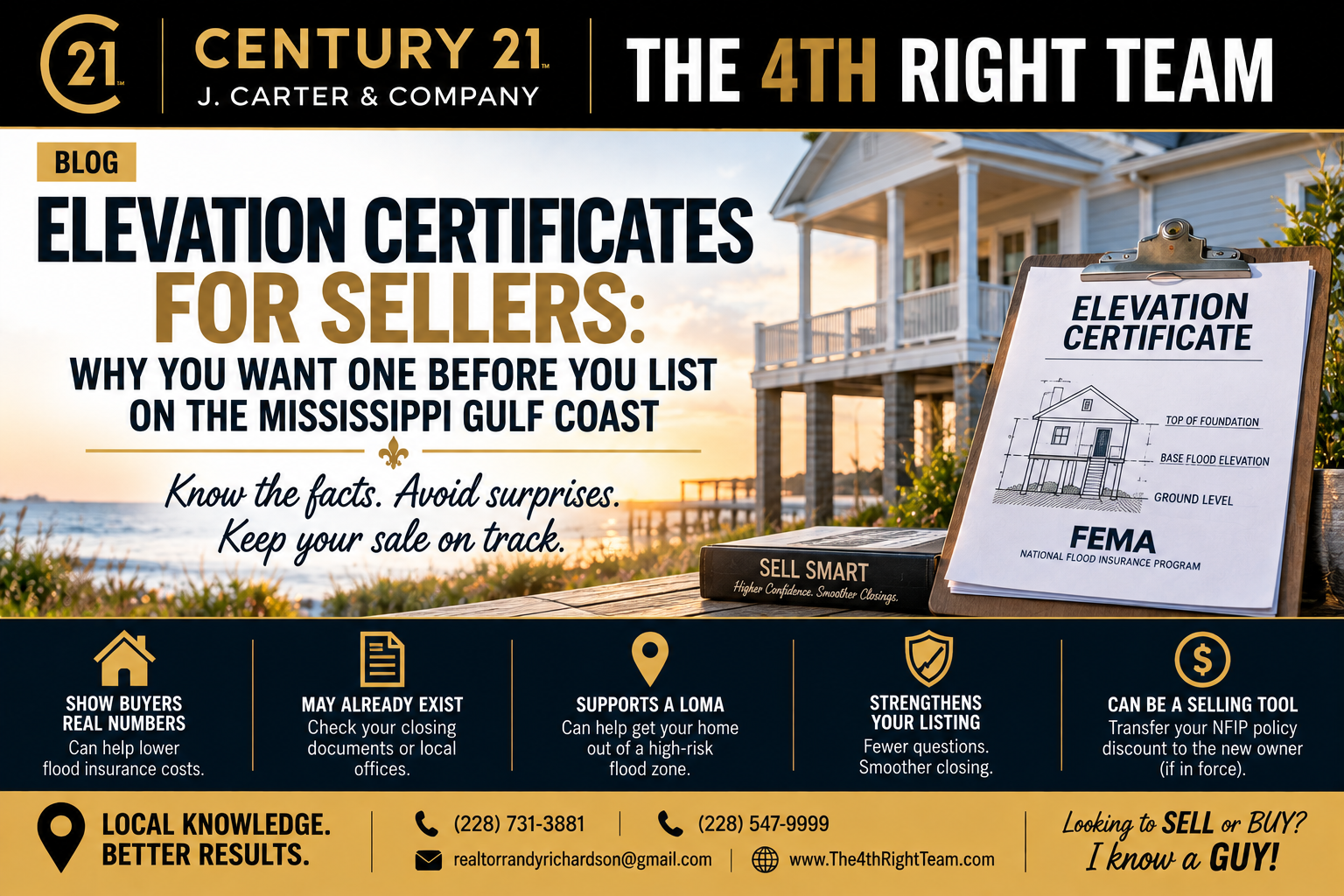
An elevation certificate replaces that guess with real measurements. It's a FEMA form signed by a licensed surveyor, engineer, or architect. It shows how high the lowest floor, the ground next to the house, and the mechanical equipment sit compared to the base flood elevation.
Under FEMA's current pricing system, a policyholder can submit an elevation certificate to their agent to see if it lowers the rate. If your house sits higher than FEMA's automated data assumes, that can make it cheaper to insure than a buyer expected. Uncertainty makes homes sit, and I cover what else adds days on market in a separate post.
Where can you find an elevation certificate you already have?
Start with the paperwork you already own. Look through your closing documents from when you bought the house, your flood insurance file, and anything the builder gave you. Your insurance agent may also have a copy.
Then check with your local floodplain office. The City of Biloxi says completed elevation certificates are available from its Community Development Department. Harrison County's flood zone rules call for a finished construction elevation certificate before final inspection on new construction in a flood zone. That means many homes built or rebuilt in flood zones after Katrina may already have one on file.
If your home is a post-Katrina rebuild in a flood zone, call your city or county permit office before you pay a surveyor. You may be able to get a copy for free.
Should you pay for a new elevation certificate before you sell?
Sometimes. If you can't find one and the home is in a high-risk flood zone, it's often worth ordering. That's especially true if the house is clearly elevated, since those are the homes most likely to rate better with real measurements.
If the home is in a lower-risk zone or you already have a recent certificate, you may not need a new one. Ask your insurance agent to look at your current policy and tell you whether a new certificate could change the premium.
Timing matters, too. Get it before you list, not after you're under contract. If you learn something that makes your seller's disclosure inaccurate, Mississippi's disclosure form requires you to amend it, and an amendment restarts the buyer's right to cancel. Talk with your agent about how to handle whatever the certificate shows.
Can an elevation certificate get your home out of the flood zone?
Not by itself, but it can support a request that does. FEMA can issue a Letter of Map Amendment, called a LOMA, that removes a structure from the high-risk flood area. FEMA doesn't charge a fee to review a LOMA request.
Here's the catch that surprises a lot of Coast homeowners. For a LOMA, the lowest ground touching the house has to be at or above the base flood elevation. It's about the ground, not the floor. A house raised high on pilings can still fail that test if the dirt around it sits below the flood line, which can happen on low-lying waterfront lots.
If FEMA grants a LOMA, the federal requirement to carry flood insurance on a federally backed mortgage goes away for that structure. Lenders can still choose to require it, though, so buyers should confirm with their lender.
How can your flood insurance policy help sell the house?
If you have an NFIP flood policy, it may be one of your best selling tools. FEMA says policyholders can transfer their discount to a new owner by assigning the policy when the property sells. For some homes, that can keep the buyer's flood cost lower than a brand-new policy would be.
That only works if the policy is still in force. A lapsed policy can't be assigned, so keep paying it through closing. That matters even more in hurricane season, when a named storm can freeze new coverage.
If the flood premium is still high, don't hide from it. Show buyers the real number, then decide whether pricing or a seller credit makes the math work. Buyers can live with a known cost. It's the unknown that makes them walk, and I explain how insurance moves the payment in another post.
What does Mississippi's seller disclosure ask about flooding?
More than many sellers expect. The Mississippi Real Estate Commission's Property Condition Disclosure Statement asks whether any part of the property is in a FEMA flood hazard zone and which zone it is. It asks whether the home has ever flooded from rising water. It also asks whether flood insurance is currently required, what premium you're paying, and when that premium was last adjusted.
The form doesn't ask for the elevation certificate itself. But when you have one ready, those answers are faster, cleaner, and easier to back up. It also cuts down on the kind of surprises that make a deal fall through late.
Under the form's rules, the disclosure has to reach the buyer before they sign an offer. If it's amended later, the buyer gets three days after in-person delivery, or five days after it's mailed, to cancel and get their earnest money back.
By the Numbers
Elevation certificate required to buy an NFIP policy under FEMA's current pricing: No
FEMA fee to review a LOMA request: $0
LOMA test: lowest ground touching the house at or above the base flood elevation
Buyer's window to cancel after an amended Mississippi disclosure: 3 days in person, 5 days by mail
Year Biloxi's current flood elevations took effect: 2009
The Bottom Line
In a flood zone, the seller with the paperwork ready usually has the smoother sale. Find your elevation certificate, keep your flood policy active, and fill out the flood section of your disclosure with real numbers. If you're thinking about selling, start with a free home evaluation. Then see how I sell homes on the Coast.
Frequently Asked Questions
Do sellers have to provide an elevation certificate in Mississippi?
Mississippi's Property Condition Disclosure Statement doesn't ask for the certificate itself. It does ask about the flood zone, any flooding from rising water, and whether flood insurance is required and what it costs. Having the certificate ready makes those answers easier to support.
Where can I get a copy of my elevation certificate?
Check your closing papers, your flood insurance file, and your builder's documents first. Then ask your city or county floodplain office. The City of Biloxi says completed certificates are available from its Community Development Department.
Can a buyer take over my flood insurance policy?
Often, yes. FEMA says an NFIP policyholder can transfer their discount to a new owner by assigning the policy when the home sells. The policy has to still be in force, so keep paying it through closing.
Can an elevation certificate remove my home from a flood zone?
Only through a FEMA Letter of Map Amendment. For a LOMA, the lowest ground touching the house must be at or above the base flood elevation. FEMA doesn't charge a fee to review the request.
Sources
FEMA, NFIP's Pricing Approach. Assigning a policy and transferring discounts to a new owner: https://www.fema.gov/flood-insurance/risk-rating
FEMA, Risk Rating 2.0 fact sheet (April 2025). Elevation certificates optional and submitting one to check for a lower rate: https://www.fema.gov/sites/default/files/documents/fema_rr-2.0_04-2025.pdf
FEMA, How to Request a Letter of Map Amendment or Letter of Map Revision Based on Fill. Lowest adjacent grade rule and no review fee: https://www.fema.gov/sites/default/files/documents/fema_request-loma-lomrf.pdf
FEMA, Letter of Map Amendment tutorials. Removal of the federal flood insurance purchase requirement and lender discretion: https://www.fema.gov/flood-maps/tutorials/letter-map-amendment
Coalition for Sustainable Flood Insurance, Risk Rating 2.0. Lapsed policies can't be assigned: https://csfi.info/risk-rating-2-0/
Mississippi Real Estate Commission, Property Condition Disclosure Statement. Flood questions, delivery timing, and amendment rules: https://www.mrec.ms.gov/forms/mrec-forms-pcds-fillable-form-letter-size-04-19-2023/
City of Biloxi, Flood Zone Map and Information (2025). Completed elevation certificates and 2009 flood elevations: https://biloxi.ms.us/wp-content/uploads/2025/05/Flood-zone-map-and-information-2025.pdf
Harrison County Code Administration, Flood Zones. Finished construction elevation certificate before final inspection: http://co.harrison.ms.us/departments/code/floodzones.asp
About the Author
I'm Randy Richardson, Broker Associate and Team Leader of The 4th Right Team at CENTURY 21 J. Carter & Company. I help buyers and sellers across the Mississippi Gulf Coast make smart moves, from the first showing to the closing table.
Randy Richardson | Broker Associate
The 4th Right Team | Century 21 J. Carter & Company
📞 Office: (228) 731-3881 | Cell: (228) 547-9999
📧 realtorrandyrichardson@gmail.com
🌐 www.The4thRightTeam.com
Looking to SELL or BUY? I know a GUY!