

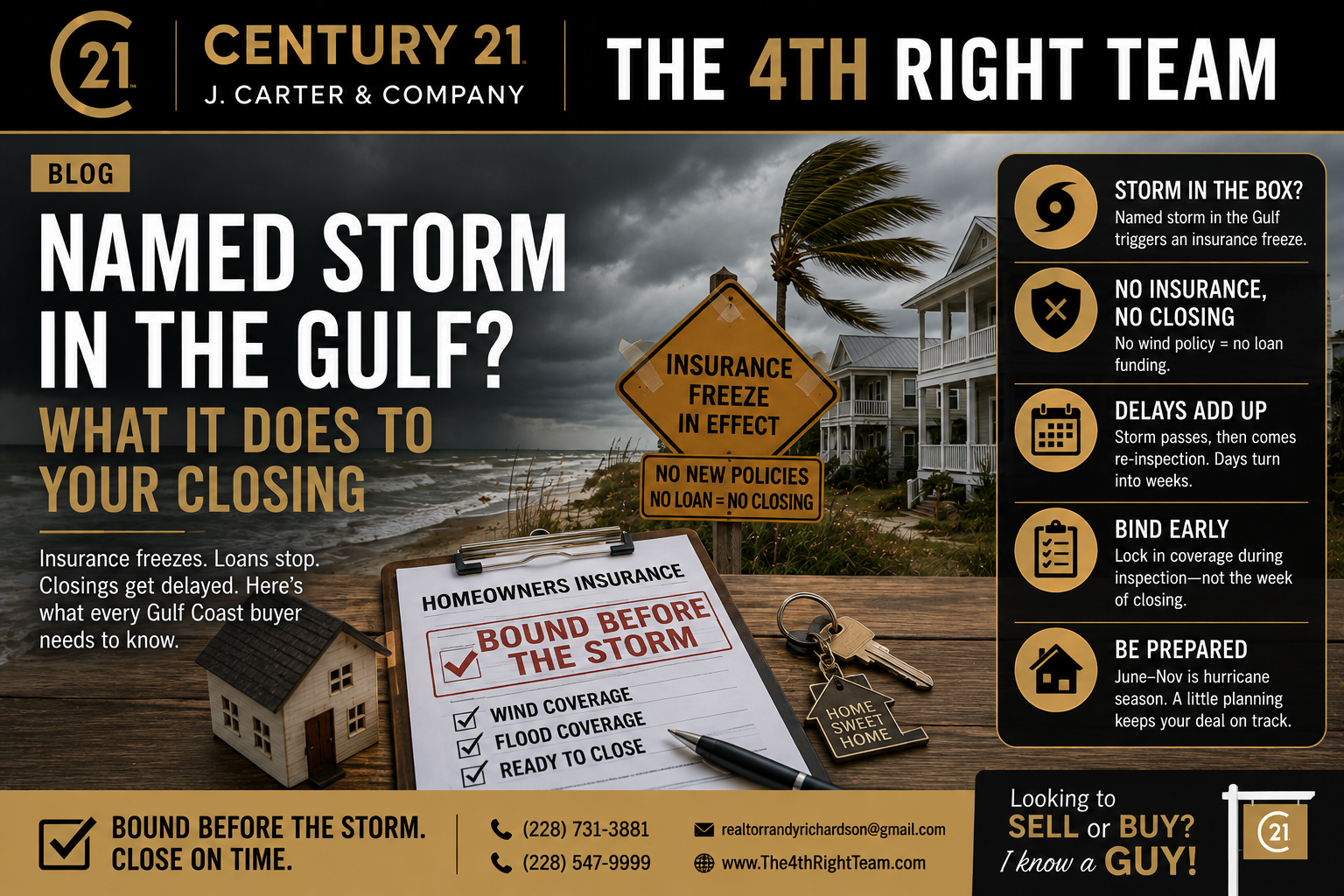
Blog > Named Storm in the Gulf? What It Does to Your Closing
By Randy Richardson, Broker Associate, The 4th Right Team
This post is part of our Mississippi Gulf Coast home insurance guide.
Quick Answer: When a named storm enters the Gulf, insurance carriers stop writing new policies. It's called a binding moratorium. Mississippi's Wind Pool won't bind coverage or issue a policy when a named storm sits inside 80 degrees west longitude and 20 degrees north latitude, and most private carriers have similar triggers. No bound homeowners and wind coverage means no loan funding. And no loan funding means no closing, no matter what your contract says.
Most buyers on the Mississippi Gulf Coast have never heard of this until it happens to them. Then they're sitting at the title company with a moving truck loaded and nothing to sign. Here's how it actually works, and how to keep it away from your deal.
What is a binding moratorium in real estate?
A binding moratorium is a temporary freeze on new insurance. Carriers stop writing new policies. They also stop letting people increase coverage on policies they already have. The freeze starts the moment a storm gets named and reaches a set point on the map.
If your policy is already bound, you're fine. Nothing gets canceled. The freeze only blocks new business and coverage increases. That's the whole game. Bound before the storm, you close. Not bound, you wait.
What is the box, and how close does a storm have to be?
The box is the trigger area, and it's a lot bigger than most people expect. The Mississippi Windstorm Underwriting Association is blunt about it. MWUA will not bind coverage or issue a policy when NOAA's National Hurricane Center declares a named storm to be within 80 degrees west longitude and 20 degrees north latitude. The Mississippi Residential Property Insurance Underwriting Association uses the same trigger.
Picture where that line falls. Eighty degrees west runs down past Miami and through the Florida Straits. Twenty degrees north sits down near Jamaica. So the box covers the whole Gulf, the Florida peninsula, the Yucatan Channel, and a big piece of the western Caribbean.
A tropical storm spinning off Cancun is inside the box. It might never get within 500 miles of Biloxi. Your closing still sits. Private carriers draw their own boxes, and most trigger on similar language or on a watch or warning anywhere near the coast. Your insurance agent has to check carrier by carrier.
Why does no insurance mean no closing?
Your lender won't fund without proof of coverage in force at closing. That's not a preference. It's a condition of the loan.
On the Coast today, most buyers carry one homeowners policy with wind and hail included, plus flood if the property sits in a Special Flood Hazard Area. Some homes still need separate wind coverage, and a few end up in the Wind Pool. Whatever the setup, miss any required piece and the file doesn't fund.
Title can be clear. The appraisal can be in. The buyer can be sitting in the parking lot with a cashier's check. Without bound coverage, nothing moves.
Does a named storm stop flood insurance too?
Flood works differently, and it usually works in your favor. NFIP policies carry a standard 30-day waiting period. But there's an exception for loan closings. If flood coverage is required as part of making the loan, coverage takes effect at closing with no waiting period, as long as the application and the premium are presented at or before closing.
That's why the federal flood program doesn't need a storm moratorium. The waiting period already blocks last-minute buying. Two cautions. Private flood carriers set their own rules and can freeze. And if the premium payment gets delivered late, that zero-day exception can be lost and the 30-day clock starts over.
When does the freeze lift?
For the state plans, the moratorium runs until the National Weather Service drops the named storm status for that event. That can be two days. It can be a week.
Then comes the part nobody plans for. After a storm passes, carriers commonly want a re-inspection or a signed statement that the home took no damage before they'll bind. That adds days on the back end. Based on how these files typically move on the Coast, a three-day storm can turn into a ten-day delay.
How do you keep a storm out of your closing?
Bind during the inspection period, not the week of closing. That's the whole answer.
Better yet, get the quote before you write the offer. Then bind within the first few days under contract, with a future effective date that matches your closing date. If the home does end up needing Wind Pool coverage, MWUA coverage takes effect at 12:01 a.m. the day after the application and payment are received, unless the application asks for a later date. So you can lock it in early and still have it start the day you sign.
Do the same with flood. Order the elevation certificate early if the property needs one. From June 1 through November 30, treat insurance as a day-one task, not a week-eight task. Don't let a quiet forecast change that. NOAA's outlook covers overall activity, not where storms land, and one storm in the box is all it takes. Our hurricane season closing checklist walks through the rest.
By the Numbers
Six Mississippi counties eligible for MWUA wind coverage: George, Hancock, Harrison, Jackson, Pearl River, and Stone
Trigger point for the state Wind Pool: 80 degrees west longitude, 20 degrees north latitude
NFIP standard waiting period: 30 days
NFIP waiting period tied to a loan closing: zero days
Atlantic hurricane season: June 1 through November 30
NOAA's August 2026 update forecast: 7 to 13 named storms for the season
MWUA coverage effective time: 12:01 a.m. the day after application and payment are received
Typical delay when a three-day storm triggers a moratorium and post-storm re-inspection: about ten days (estimate based on local experience)
The Bottom Line
A named storm in the Gulf can't touch a policy that's already bound. It can absolutely stall one that isn't. If you're buying on the Coast between June and November, get your insurance and flood quotes the same week you go under contract. That one habit takes the whole problem off the table. It's the kind of thing a local agent thinks about in July and a national relocation website never mentions at all. If you're just starting, our Coast home insurance buyer's guide puts the Coast-specific steps in order.
Frequently Asked Questions
Can I buy homeowners insurance while a hurricane is in the Gulf?
Usually not. Mississippi's wind pool will not bind new coverage or increase existing coverage while a named storm is within 80 degrees west longitude and 20 degrees north latitude. Most private carriers follow similar rules.
Will a named storm cancel my closing or just delay it?
Almost always just delay it. Your contract may need an extension, but the deal itself stays alive. Talk to your agent about a written extension before the closing date passes.
Does the storm have to be near Mississippi to stop my closing?
No. The trigger is a map box, not a forecast track. A storm near Cuba or the Yucatan can freeze binding here even if it never threatens the Coast.
What if my policy is already in force when the storm forms?
You're covered. Existing policies stay in force. The freeze only stops new policies and coverage increases, which is exactly why binding early matters.
When should I get insurance quotes when buying on the Coast?
The first week you're under contract. Get wind, flood, and homeowners quotes together, then bind with an effective date that matches closing.
Sources
Mississippi Windstorm Underwriting Association: Binding restriction and named storm moratorium notices
Mississippi Windstorm Underwriting Association: Eligible counties
Mississippi Residential Property Insurance Underwriting Association: Same named storm trigger and when the moratorium lifts
FEMA NFIP Bulletin W-09065: 30-day standard waiting period and the loan closing exception
NOAA, August 6, 2026 Atlantic hurricane season update: Named storm forecast range
Keep reading: Hurricane Season Closing Checklist for Mississippi Gulf Coast Buyers and Sellers and Coast Buyers: Get the Insurance Quote Before the Offer
Randy Richardson | Broker Associate
The 4th Right Team | Century 21 J. Carter & Company
📞 Office: (228) 731-3881 | Cell: (228) 547-9999
📧 realtorrandyrichardson@gmail.com
🌐 www.The4thRightTeam.com
Looking to SELL or BUY? I know a GUY!