


Blog > Escrow Shock: Why Your Mortgage Payment Jumped in Year Two on the Gulf Coast
Escrow Shock: Why Your Mortgage Payment Jumped in Year Two on the Gulf Coast
by
By Randy Richardson, Broker Associate, The 4th Right Team
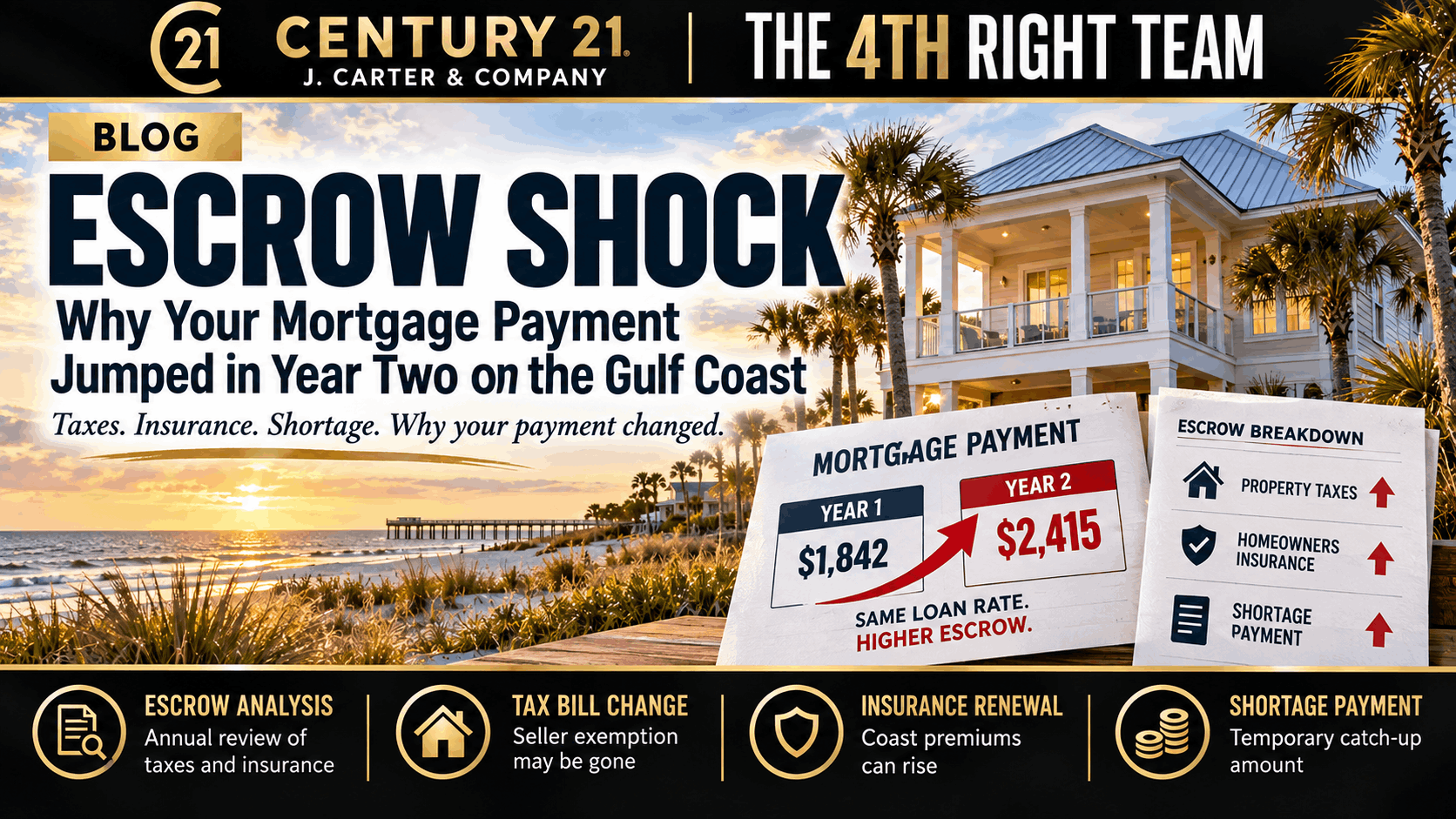
Quick Answer: If your Mississippi Gulf Coast mortgage payment jumped in year two, it's almost always the escrow account, not your loan. Your first year's escrow was usually built off the seller's tax bill and your first insurance premium. When the real bills come in higher, your servicer's annual escrow analysis does two things at once: it raises your monthly deposit to cover the new bills, and it adds a shortage payment to make up what the account came up short. That double hit is the shock. The shortage part goes away after it's repaid, and filing your homestead exemption can bring the tax side back down.
What is an escrow account, and why does it change?
Most Coast mortgages include an escrow account. Each month, part of your payment goes into it, and your servicer uses that money to pay your property taxes and your insurance premiums when they're due. Your principal and interest stay the same on a fixed-rate loan. The escrow part moves with your bills.
Once a year, your servicer runs an escrow analysis. It looks at what it paid out, what's coming due next year, and whether the account has enough. Federal rules let the servicer keep a cushion of up to one-sixth of the year's escrow bills, which is about two months' worth. If the account is headed below that, you've got a shortage.
Why does escrow go up so much after the first year on the Coast?
Because the first year's numbers were a guess, and on the Coast the guess usually runs low.
The biggest reason is property taxes. Mississippi bills taxes a year behind, and your first bill after closing often reflects the seller's homestead exemption, not your situation. Once that exemption drops off, the same house can be assessed at a higher rate, often on an updated value. I walk through why in my post on how the tax bill jumps the year after you buy. New construction can be even more dramatic, since the first bill may cover only the land.
Insurance is the second reason. Kelsey Carlson, CISR Elite, a Personal Lines Risk Advisor at Lemon Mohler Insurance, told me most 2026 first renewals have been calm, a couple hundred dollars if anything, and some are flat or down. But some policies carry an inflation guard that automatically raises your dwelling coverage each year, which raises the premium with it. Ask your agent how your renewal works. If you have NFIP flood insurance, FEMA's Risk Rating 2.0 lets most premiums rise up to 18% a year until they reach the full-risk rate.
What does an escrow shortage look like in real numbers?
Here's a simplified example. Say your first-year escrow was built on a $1,800 tax bill and a $2,400 insurance premium. That's $4,200 a year, or $350 a month.
In year two, the tax bill comes in at $3,300 without the seller's exemption, and insurance renews at $2,600. That's $5,900 a year, or about $492 a month. The account also paid out $1,700 more than it collected, and the servicer needs to rebuild the cushion at the new, higher level. That puts the shortage at about $1,983.
Spread over 12 months, the shortage adds about $165 a month. So your escrow goes from $350 to about $657 a month in year two, a jump of roughly $307. In year three, once the shortage is repaid, it settles at about $492. Your real long-term increase is about $142 a month, not $307. Plug your own numbers into the mortgage calculator to see the full payment.
Do I have to pay an escrow shortage all at once?
Usually not. Under federal escrow rules, if the shortage is less than one month's escrow payment, the servicer can ask you to pay it within 30 days or spread it out. If it's one month's payment or more and the servicer wants it repaid, it has to spread it over at least 12 months. You can almost always choose to pay it in a lump sum instead, which keeps your monthly payment lower.
Going the other way, if the analysis finds a surplus of $50 or more, the servicer generally has to refund it within 30 days. That happens more than people think after a tax appeal or a homestead filing lowers the bill.
How can I lower my escrow payment on the Gulf Coast?
Start with the tax side. If you haven't filed your homestead exemption, file it at your county tax assessor's office. The window runs from January 1 to April 1. Once the lower bill shows up, ask your servicer to run a new escrow analysis instead of waiting a full year.
Then look at insurance. Shop the policy with your agent before renewal. The Strengthen Mississippi Homes program can help pay for a FORTIFIED roof. That roof, or a completed wind mitigation form, can lower the wind coverage cost. For flood, an elevation certificate with good numbers can help. Don't drop flood coverage to save money, though. Even where the lender doesn't require it, a home outside the high-risk zone can still flood.
Finally, read the escrow analysis itself. Check that the tax and insurance amounts match your actual bills. Mistakes happen, and a servicer projecting last year's premium or the wrong tax bill can inflate your payment for a full year. If something's off, call your servicer or your lender and ask for a corrected analysis.
What should buyers do before closing so this doesn't surprise them?
Budget for year two, not year one. Ask your lender to estimate escrow using what the taxes will be on your purchase price with your own homestead status, not the seller's old bill. The escrow deposit you pay at closing is part of your closing costs, and it's built from those same estimates.
Get an insurance quote before you write an offer so the premium in your budget is real. If the home already has an NFIP flood policy, ask about assuming it. A buyer who takes over the seller's policy can keep its place on the 18% glide path instead of starting over at a new rate.
By the Numbers
Maximum escrow cushion under federal rules: one-sixth of annual escrow bills, about two months
Shortage of one month's payment or more: spread over at least 12 months if the servicer requires repayment
Surplus refund threshold: $50
Most NFIP flood premium increases: capped at 18% a year
Mississippi homestead filing window: January 1 to April 1
Example year-one escrow: $350 a month
Example year-two escrow with shortage: about $657 a month
Example year-three escrow after the shortage is repaid: about $492 a month
The Bottom Line
A year-two payment jump on the Coast is usually escrow catching up with real tax and insurance bills, plus a one-time shortage on top. File your homestead exemption, shop your insurance, read your escrow analysis line by line, and remember that the shortage part goes away once it's repaid.
If you're still shopping for a home, my buyer's guide covers how to budget for the real costs of owning on the Coast.
Frequently Asked Questions
Why did my mortgage payment go up if I have a fixed rate?
Your principal and interest didn't change. Your escrow did. Higher property taxes or insurance, plus a shortage from the past year, raise the escrow part of your payment.
What is an escrow shortage?
It's when your escrow account won't have enough to pay the coming year's bills and keep the allowed cushion. The servicer can spread repayment over 12 months, or you can usually pay it in a lump sum.
Will my payment go back down after the shortage is paid?
Partly. The shortage payment ends once it's repaid, but the higher monthly deposit for the new tax and insurance bills stays unless those bills drop.
How can I lower my escrow payment in Mississippi?
File your homestead exemption between January 1 and April 1, shop your homeowners insurance before renewal, and check your escrow analysis for errors. Then ask your servicer for a new analysis.
Sources
Escrow cushion, shortage and surplus rules: CFPB Regulation X, 12 CFR 1024.17, Escrow accounts
NFIP annual increase cap: FEMA Fact Sheet, Understanding Risk Rating 2.0 (July 2025)
Buyers assuming a seller's NFIP policy and glide path: Bankrate, Flood insurance rate changes
Mississippi property taxes paid in arrears and homestead filing: Mississippi State University Extension, Understanding Mississippi Property Taxes
2026 renewal trends and inflation guard: Kelsey Carlson, CISR Elite, Personal Lines Risk Advisor, Lemon Mohler Insurance, written answers, September 2026
Example escrow figures: calculated for this post, simplified and illustrative only
About the Author
Randy Richardson is a Broker Associate and Team Leader of The 4th Right Team at CENTURY 21 J. Carter & Company. He serves buyers and sellers across the Mississippi Gulf Coast.
Randy Richardson | Broker Associate
The 4th Right Team | Century 21 J. Carter & Company
📞 Office: (228) 731-3881 | Cell: (228) 547-9999
📧 realtorrandyrichardson@gmail.com
🌐 www.The4thRightTeam.com
Looking to SELL or BUY? I know a GUY!