


Blog > Mississippi Seller Disclosure: Flooding and Storm Damage
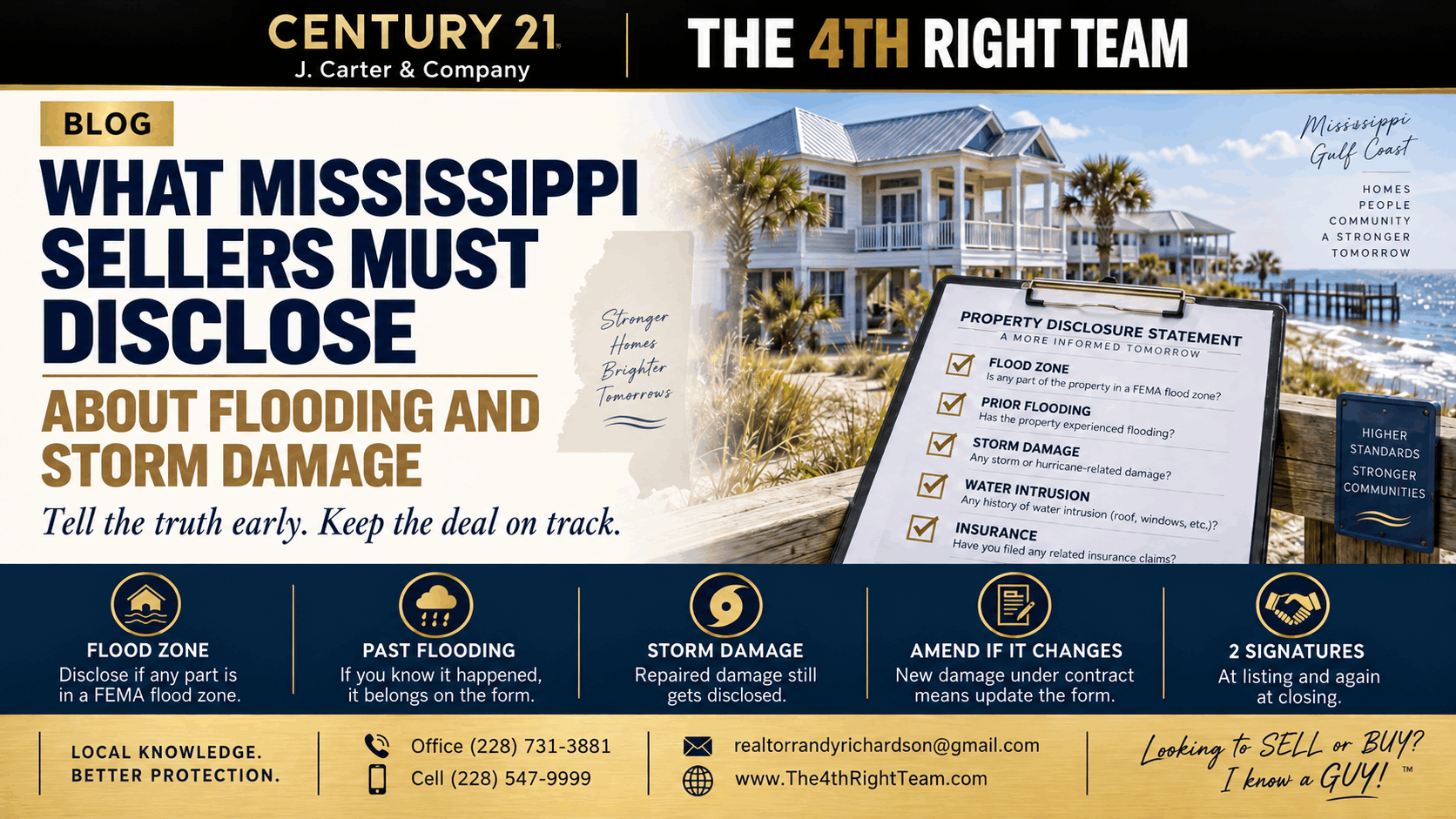
What Mississippi Sellers Must Disclose About Flooding and Storm Damage
By Randy Richardson, Broker Associate, The 4th Right Team
Quick Answer: Mississippi sellers fill out the Property Condition Disclosure Statement, and it asks directly about flooding and storm damage. The form asks whether the home has ever been flooded by rising water from the outside, whether any part of the property sits in a FEMA designated flood hazard zone, and whether the structure has ever been damaged by hurricane, windstorm, hail, tornado, fire, or other disaster. You answer based on your actual personal knowledge, not on what an inspector might find later. You sign it when you list, and you sign it again at closing certifying it's still true. On the Coast, that second signature matters more than most sellers realize.
What does Mississippi law actually require sellers to disclose?
The rules live in Mississippi Code sections 89-1-501 through 89-1-527. They cover residential property of one to four units. The seller completes the Property Condition Disclosure Statement, usually called the PCDS, and the Mississippi Real Estate Commission decides what's on it. Mississippi is not a pure buyer beware state here. You report what you actually know. You're not required to go test or inspect anything first. But if you know it, it belongs on the form.
Timing matters. The buyer should have the PCDS before they sign an offer. If it lands after that, or if you amend it later, the buyer gets three days after in-person delivery or five days after mailing to terminate and take their earnest money back. That's why I have sellers complete it the day we list, not the week of closing. A late disclosure hands a nervous buyer a free exit.
What does the PCDS ask about flooding and storm damage?
More than most sellers expect. Section V asks whether any portion of the property is currently in a FEMA designated flood hazard zone, and if it is, which zone letter. It asks whether the residence has ever been flooded by rising water from the outside. It asks whether flood insurance is currently required, and if so, what the premium is and when it was last adjusted. That last one surprises people. You're disclosing a number, not just a yes.
Then it gets granular. One question covers water penetration or damage to walls, windows, doors, crawl space, attic, and basement. The next asks what caused it, with twelve boxes including flooding, lot drainage, sewer backup, moisture seep, and broken pipes. Storm damage sits up in Section IV, where six boxes ask whether any portion of the structure has ever been damaged by fire, windstorm, hail, tornados, hurricane, or other disaster. The word doing the heavy lifting is "ever." It isn't limited to your years in the house if you know what happened before you.
If your home sits on the water, expect more questions and more scrutiny. A buyer's agent who understands waterfront property will read that section closely, and their insurance agent will usually ask for an elevation certificate right behind it.
Do I have to disclose damage that's already been repaired?
Yes, if you know about it. The form asks about damage, not unrepaired damage. A roof replaced after Zeta still counts as wind damage to the structure. Water that came in during a 2019 storm still counts, even though you replaced the flooring and it's been dry every day since.
Repaired damage is the easiest thing to disclose well. Write a real explanation, name the contractor, and attach the invoice, the permit, and the claim paperwork. A buyer who reads "hurricane damage 2020, roof replaced, invoice attached" settles down. A buyer who finds an old claim in a CLUE report that never made the form starts wondering what else got left off, and that's when it turns into a repair credit. Paperwork also helps on roof age, since a documented replacement date is worth money to the buyer's carrier.
What happens if a storm damages the house after we're under contract?
You amend the PCDS. The form's own certification says that if you learn something that makes a previous disclosure materially inaccurate, you deliver a revised statement as soon as practicable. Then at the closing table you sign again, certifying the information is still true and complete as of the day you close.
This is the part Coast sellers underestimate. We close a lot of homes in September and October. A named storm can change the condition of a house in six hours. If water gets in or shingles come off between contract and closing, that goes on an amendment, and the amendment restarts the buyer's three or five day termination window. Storms hit the money side too, since carriers stop binding new wind and hail coverage once a system enters the box.
What if a past owner took a Katrina grant on the property?
This one isn't on the PCDS at all, and it catches people. After Katrina, Mississippi's Homeowner Assistance Program paid grants to Coast homeowners in Hancock, Harrison, Jackson, and Pearl River counties. In exchange, a covenant went on the property. HUD's own announcement of the second phase says the covenant obligates all current and future homeowners to comply with building code, flood insurance, and elevation requirements.
So a home in Bay St. Louis or Pass Christian that came back with grant money can carry a permanent flood insurance obligation, even if it later maps into a lower risk zone. Title work should catch it, so ask your closing attorney to look early. If it's there, say so up front, because insurance moves the payment. The same goes for any post-Katrina rebuild where elevation and code work were part of the deal.
What happens if a seller leaves flooding off the form?
Here I'll be careful, because a lot of websites still quote a law that's gone. Mississippi Code section 89-1-521, the part that spelled out damages against a seller who willfully or negligently violated the disclosure duty, was repealed in 2023. A separate section says a transfer can't be invalidated just because someone failed to comply with the disclosure requirements.
That does not make hiding things safe. The PCDS itself warns sellers that a knowingly false or incomplete statement may subject the seller to claims by the buyer before or after the transfer of title. Mississippi's general law on fraud and misrepresentation didn't go anywhere. And the real cost is rarely a lawsuit. It's a buyer who walks during inspections, a lender who won't fund, or a listing racking up days on market while the story spreads through a small agent community. If you've got a disclosure question with real money attached, call a closing attorney before you sign.
By the Numbers
1 to 4 units — residential property covered by the PCDS requirement.
3 days in person, 5 days by mail — buyer's window to terminate after a late disclosure or an amendment.
6 boxes — storm damage causes listed in Section IV: fire, windstorm, hail, tornados, hurricane, other disaster.
6 locations and 12 causes — water damage checkboxes in Section V.
2 signatures — seller signs at listing and again at closing.
2023 — year Mississippi repealed Code section 89-1-521, the old disclosure damages provision.
4 counties — Hancock, Harrison, Jackson, and Pearl River, covered by Katrina Homeowner Assistance Program Phase II grants and their covenants.
The Bottom Line
Disclosing flooding and storm damage the right way protects the sale more than it threatens it. Coast buyers already assume every house here has a weather history, and the ones who walk are the ones who found out late. Fill the form out fully at listing, attach the paperwork, and amend it the moment something changes. If you want a straight read on what your home is worth before you start, or how the listing process works from here, that's a conversation worth having early. A local agent can walk the form with you line by line.
Frequently Asked Questions
Do I have to disclose flooding that happened before I owned the home?
If you know about it, yes. The form asks whether the residence has ever been flooded by rising water from the outside. It's based on your actual knowledge, so you aren't expected to dig up history you've never heard about. But you can't ignore what a neighbor, a prior owner, or your own insurance file told you.
Does being in a FEMA flood zone by itself have to be disclosed?
Yes. The PCDS asks whether any portion of the property is currently in a FEMA designated flood hazard zone and asks for the zone classification. It also asks whether flood insurance is currently required, along with the premium and when it was last adjusted.
What if I don't know the answer to a question?
Mark it Unknown. The form gives you Yes, No, Unknown, and NA for a reason. Guessing yes or no when you don't actually know is the risky move, not admitting you don't know.
Can I sell a Mississippi home without giving a disclosure?
Some transfers are excluded, like foreclosures, estate transfers by a fiduciary, transfers to a spouse, and land with no dwelling. There's also a path for a seller who never lived in the property and has no knowledge of its condition. Confirm with your closing attorney before assuming one applies.
Should I get an inspection before I list on the Coast?
You don't have to, and it does mean you'll then know about anything it finds. Still, a pre-listing inspection usually beats a surprise during the buyer's option period, especially on water damage and roofs where insurance is involved.
Sources
Mississippi Real Estate Commission, Property Condition Disclosure Statement — flood zone, flooding, flood insurance, water damage and storm damage questions; seller certification and closing certification; statutory exclusions; three day and five day termination windows.
Mississippi Code § 89-1-503 — delivery requirement and the buyer's right to terminate after a late disclosure or material amendment.
Mississippi Code § 89-1-521 — repealed by Laws 2023, ch. 385, § 9, effective March 14, 2023.
Mississippi Code § 89-1-523 — noncompliance does not invalidate a transfer.
U.S. Department of Housing and Urban Development, news release on Mississippi Homeowner Assistance Program Phase II — covenants binding current and future owners to building code, flood insurance, and elevation requirements in Hancock, Harrison, Jackson, and Pearl River counties.
Randy Richardson | Broker Associate
Broker Associate and Team Leader of The 4th Right Team at CENTURY 21 J. Carter & Company. Randy works with buyers and sellers across the Mississippi Gulf Coast.
📞 Office: (228) 731-3881 | Cell: (228) 547-9999
📧 realtorrandyrichardson@gmail.com
🌐 www.The4thRightTeam.com
Looking to SELL or BUY? I know a GUY!
This article is general information about Mississippi disclosure practice, not legal advice. For a specific property, talk with a licensed Mississippi closing attorney.